You have definietely heard about the Dangoted Refinery IPO, but do you know what you need to know before you dip your feet into the waters?
This time around, we decided to have a roundtable with our friends and partners at Imaginarium, a foremost marketing and communications agency based in Nigeria. We came up with several hypothesis around key industries that both entities often interface with and were heavily affected by the socio-political landscape in Nigeria. These industries includes: Fast Moving Consumer Goods (FMCG), Banking and Finance, Technology, Investments & Consumer habits & Economic influence. The consumer insights gathered is focused mainly in Nigeria where we have collected data around relevant topics from each sector.
In our eleventh Versus report series, in collaboration with our friends at Imaginarium - we delve into a hypothesis driven intelligence report where we conclude with direct and honest feedback from our Versus scouts' respondents across Nigeria. We also highlight where we see opportunities as well as make some bold predictions on where we see things panning out for these key sectors.
Since the Federal Government of Nigeria declared its first lockdown in selected states on March 30th, companies, schools, and religious organizations have adopted remote and online mediums of collaborating and transacting for work, learning, entertainment, religious activities, and even when paying for commodities. This has put the Telecommunications and Banking sectors in the spotlight in providing smooth services.


Sentiment Distribution (online news, forums & blogs) - the topmost trafficked sites and at least 1000 articles from each Nigerian site, and 500 from each Kenyan site.
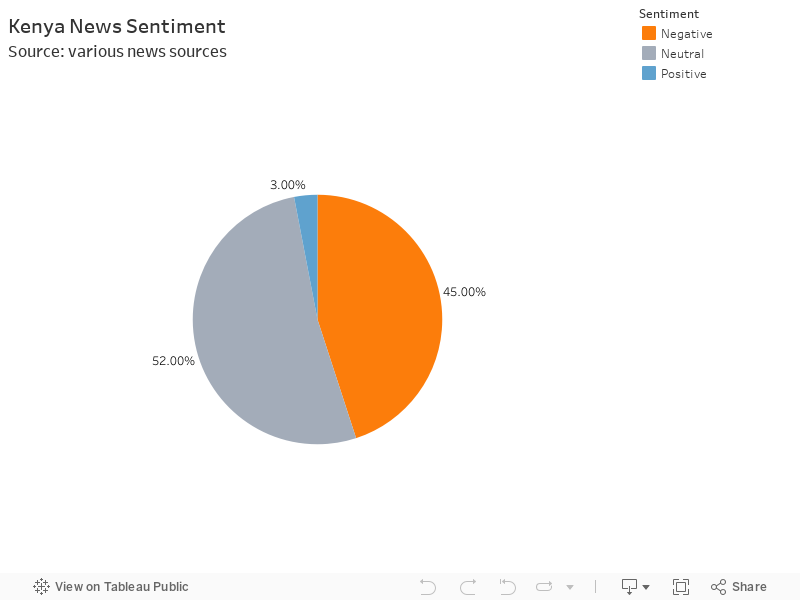
In Nigeria, sentiment trended mostly negative. (see “Key Pointers and Observations”)
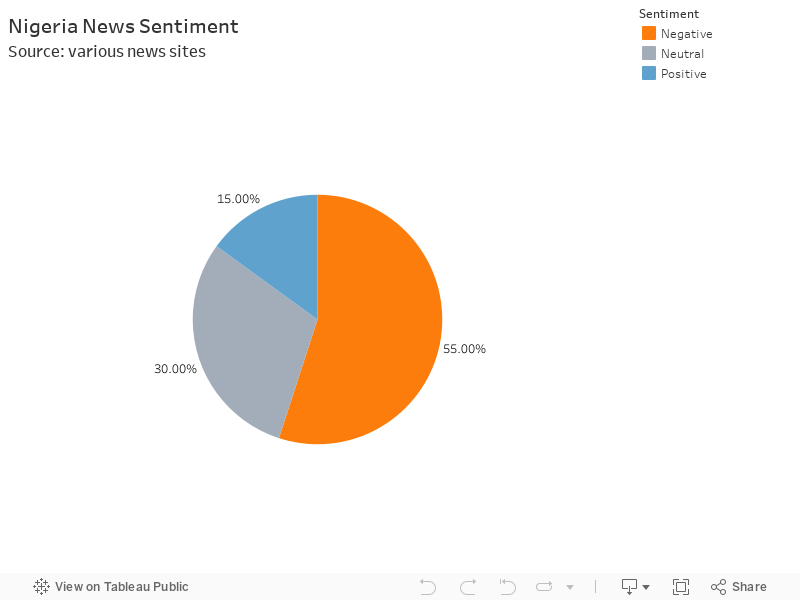
In Kenya, sentiment trended mostly neutral, with a high percentage of negative sentiment. (see “Key Pointers and Observations”)
We used the following keywords and hashtags:


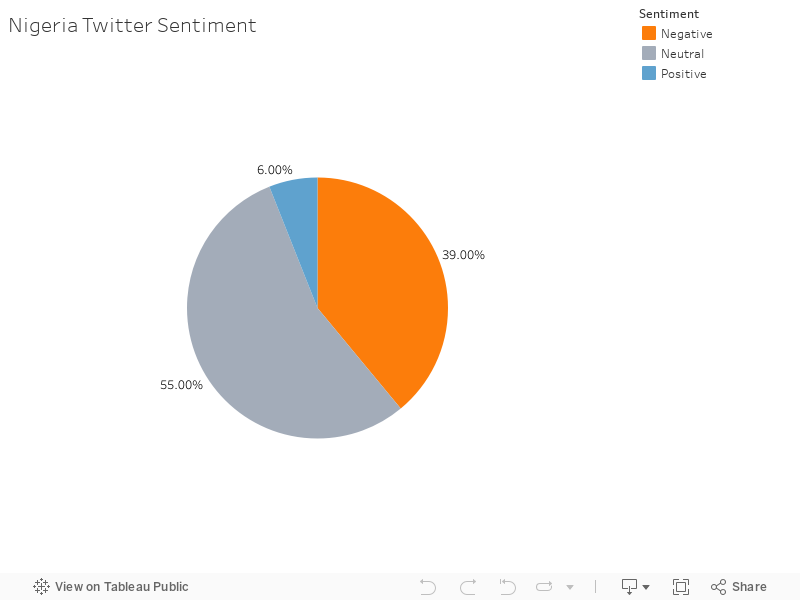
In Nigeria, Twitter chatter trended mostly neutral, with 39% negative sentiment (see “Key Pointers and Observations”).
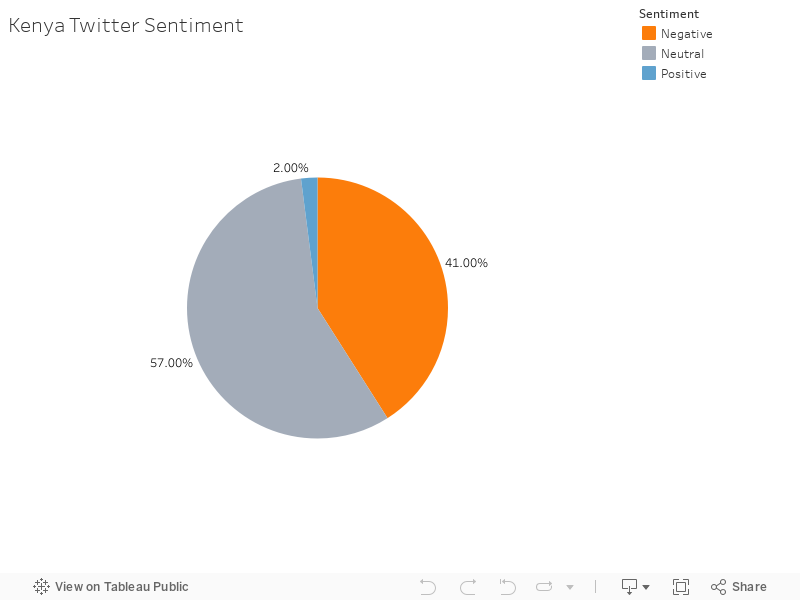
In Kenya, Twitter charter sentiment trended mostly neutral, however with a high percentage of negative sentiments (see “Key Pointers and Observations”).
Telecommunications and Internet Service Providers (ISPs) have been one of the major gainers during this lockdown. When the lockdown started on March 30th, there was a surge in Internet traffic. According to the CEO of Internet Exchange Point of Nigeria, there was a 10% increase in traffic in the first two weeks of the lockdown. More people are home and need internet data for work, school, and entertainment.
Zoom Video Communications, the video and web conferencing solution, became popular across Africa (including Nigeria and Kenya) during the lockdown. In January, Zoom’s stock price was $68.80; by May 1, its stock increased to $138.56. Zoom has boomed in popularity as people have been encouraged to practice social distancing to reduce the spread of COVID-19. Video-streaming, subscription-based media company Netflix also gained popularity during the lockdown. In January, Netflix’s stock was $326.10 and on May 1 it increased to $415.27.
Stock prices of the top virtual platforms (in dollars)
These are top platforms that have experienced an increase in demand during the pandemic in various countries. The need to continue working, learning and staying entertained during this period has increased the demand for these products, and by extension the increase in internet usage.
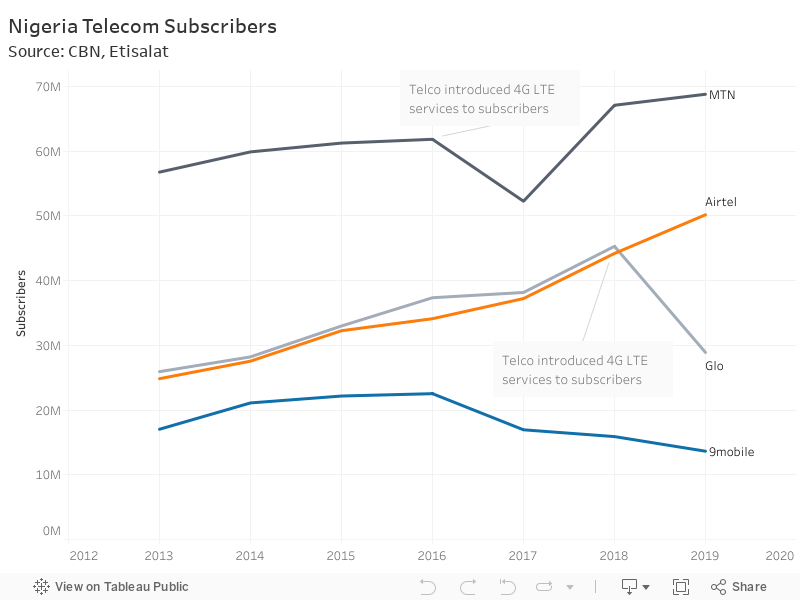
Nigeria operates one of the largest telecommunication industries in Africa with few firms in the space like Airtel, MTN, Glo, and 9mobile, as the top mobile service providers.
In 2008, 3G was officially launched in Nigeria by GloMobile, followed by MTN and Etisalat in 2011. 4G LTE -- which is said to be 10 times faster than 3G -- was launched in 2016 by MTN, followed by Glo Mobile and 9mobile. Airtel launched its 4G LTE in 2018, a development that led to an increase in their subscribers.
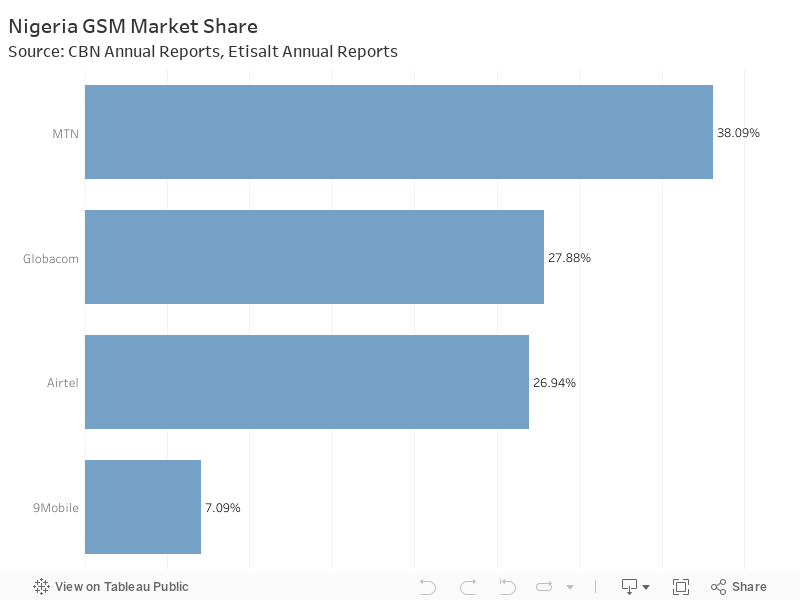
Internet Subscribers
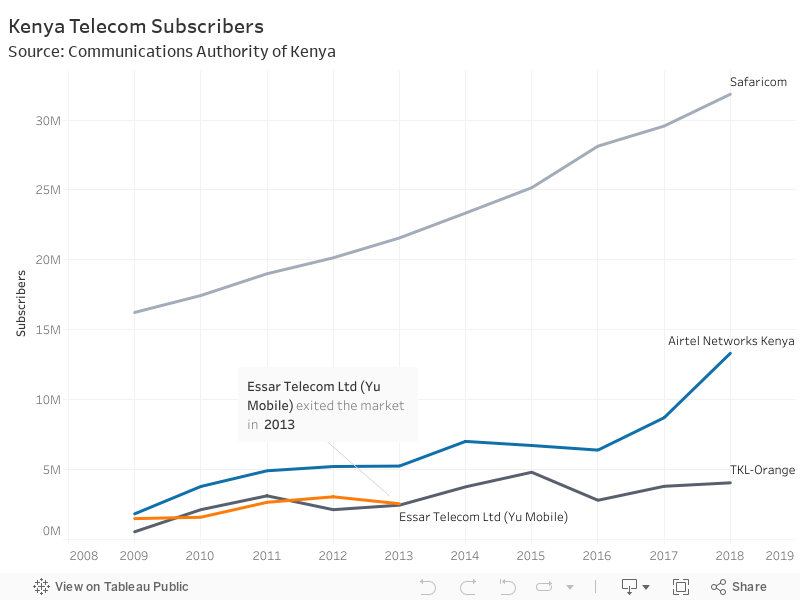
The Kenyan telecommunications sector began with the establishment of Safaricom Ltd and Airtel Networks Kenya in 1999. In 2008, two other operators joined the industry: Essar Telecom Kenya Ltd (YuMobile) and Telkom Kenya Ltd (TKL-Orange). They have seen a steady increase in the number of subscribers, with Safaricom holding the largest share of subscribers in the country to date.
During the lockdown, Nigerians have turned to entertainment streaming platforms, this has inadvertently increased the demand for internet data. This topic trended mostly neutral, as most conversations were opinion based on the show. However, most of these conversations referenced the streaming platform, which could count as a form of unsolicited advertising.
Despite the continuous scientifically-backed assurance that the 5G network has nothing to do with the Coronavirus, sentiments around this topic trended negatively on Twitter. Nigerians spoke against the 5G network with a number of them attributing the lockdown to telcos wanting to lay down the structure for 5G. This was hugely championed by twitter user @felix_ninelives
Whose handle has since been suspended for violating twitter rules.
Sentiment
Percentage
Negative
89%
Neutral
11%
Positive
0%
Insert Pie Chart
The Telecommunications sector charter in Nigeria attracted mostly negative sentiment especially from twitter, which can be linked to the alleged cover up that was attributed to the 5G network, as well as complaints by consumers spending more on data purchase since a lot of activities have been moved online.
Despite the huge technology gap amongst students in Kenya, e-learning has been adopted in cushioning the effect of restrictions placed on schools, and students are in a race against time to find the right tools to join their counterparts. Airtel Kenya partnered with Longhorn to ensure continuous access to the platform through free internet for subscribers.
Safaricom seems to be living up to its reputation as the top telecommunications provider in the country by committing towards helping the government provide for Kenyans. The various initiatives have been laudable to say the least, generally attracting positive sentiment. This topic trended 88% positive despite attracting negative sentiments from consumers due to service downtime. As reported by standard media, a leading online news source in Kenya.
Sentiment
Percentage
Negative
18%
Neutral
27%
Positive
55%
Insert Pie Chart
Sentiment around the Kenya Telecommunications sector was mostly positive during this period, largely due to the measures being put in place by Telcos to help cushion the effect of the partial lockdown due to the coronavirus in the country.
Since the lockdown started, online banking platforms (including mobile applications and Unstructured Supplementary Service Data - USSD) have become more popular. Cash transactions are not as popular in these times due to people not wanting to touch physical notes for fear of contracting the virus. Paying with an ATM card may well become the habit.
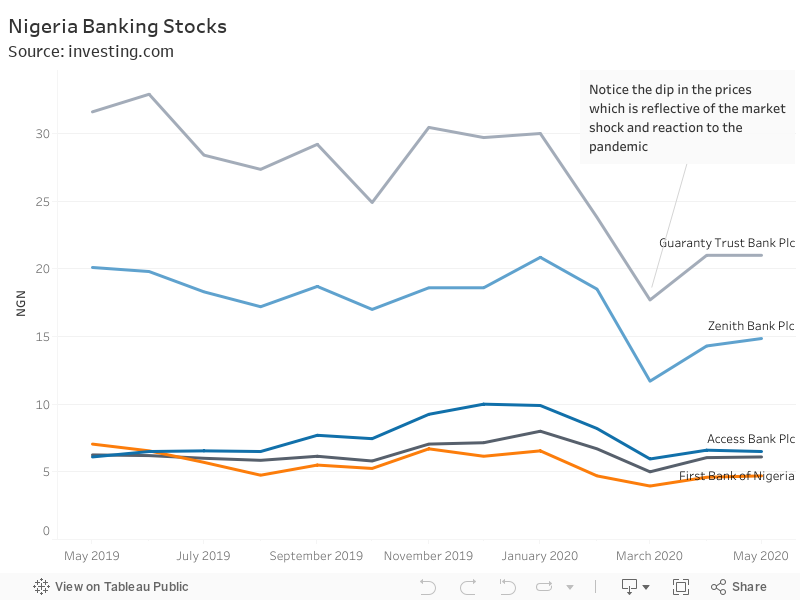
Line Graph Stock prices (in naira) of the five Tier-1 banks in Nigeria in the past year
Source: Investing.com
In general, the stock prices of the tier-1 banks have declined in the past year, especially since the coronavirus pandemic. There was also a general decline in stock prices for a lot of industries across the world.
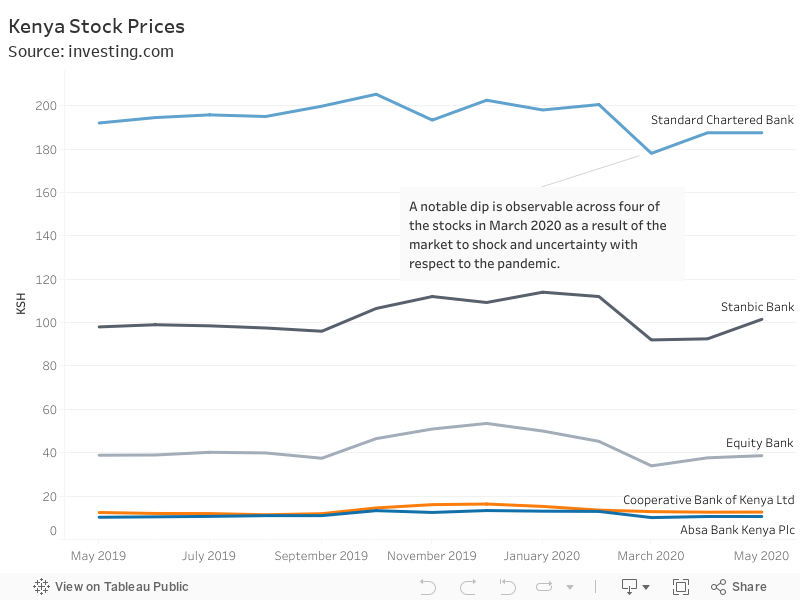
Line Graph Stock prices (in shillings) of the five Tier-1 banks in Kenya in the past year
Source: Investing.com
Stock prices of tier-1 banks in Kenya also experienced a dip. However, the decline has not been too drastic, and so far it is looking promising, with various loans being granted to help in stabilizing the Kenyan economy.
Economic Stimulus Bill 2020
The Nigerian government introduced an Emergency Economic Stimulus Bill which seeks to protect companies and alleviate the financial burden on citizens due to the economic imbalance that may arise from the Covid-19 outbreak. The bill -- effective from 1 March to December 2020 -- will grant registered companies 50% income tax rebate under the personal income tax.
Physical Banking Activities
There was an overflow of customers at some Nigerian banks that opened on the 4th of May when the lockdown was eased in Lagos and Abuja. Reasons for this could be attributed to poor internet banking services, failed transactions during the lockdown, expired ATM cards that need to be renewed, account holders with fixed deposit accounts or retirees who can only access their account using bank tellers. Even though there had been an increase in the use of digital payments, there is still a major challenge for the banks to improve on their dispute resolution and customer service. Twitter user @adelajaadeoye suggested that banks should “engage influencers on how customers can use alternative channels, ATM, e-banking, agent banking for transactions to decongest banking halls”, and observed that “the crowd in banks today is as a result of lack of basic orientation on other means of getting cash”.
Dangote Cement Plc Bond Issuance
Africa’s leading cement manufacturer, Dangote Cement Plc issued the first of its Fixed Rate Unsecured Bonds with an amount of N100 billion (about $222 million). Despite the uncertainty in the financial markets caused by COVID-19, this bond issuance has been oversubscribed by a wide range of investors like asset managers, insurance companies and banks proving to be a pseudo-stimulus for these financial institutions. Twitter user @_ikaka retweeted Nairametrics’ tweet about the news.
Tax Waiver
Despite the recent 2% reduction in VAT to 14%, some counties have also gone ahead to approve tax waivers for their local businesses and traders, to help cushion the effect of the Coronavirus. However, the implementation of 14% VAT on power consumption attracted negative sentiments around this topic.
2026 Enterfive Inc. All Rights Reserved


