
Africa’s infrastructure landscape is entering a period of significant transformation. Growing cities, expanding regional trade and rising demand for reliable energy, transport, logistics and productive infrastructure are creating both urgent development needs and significant investment opportunities. At the same time, the scale of the continent’s infrastructure requirements is driving greater attention towards private capital, new financing models and projects capable of connecting industries, markets and economies. This report explores how these shifts are unfolding across Kenya, South Africa, Egypt, Ethiopia and Nigeria, highlighting the different infrastructure priorities and investment pathways emerging across the five markets.
At the centre of the analysis is the Dangote Refinery, used as a case study to explore what large-scale, privately financed infrastructure could mean for Africa’s next phase of industrial development. The report looks beyond the project itself to consider its implications for domestic value creation, regional trade, private-sector participation and the potential for broader investor involvement in major African infrastructure assets.
The analysis is complemented by original Versus Africa cross-market research, bringing the perspectives of potential investors into the infrastructure conversation. By examining investment behaviour, attitudes towards African infrastructure, awareness of landmark projects and the factors shaping investment decisions, the report provides a view not only of where Africa’s infrastructure opportunity is emerging, but how the people who could participate in that opportunity perceive it. Together, the findings offer a forward-looking perspective on the opportunities, challenges and market dynamics likely to shape the continent’s evolving infrastructure investment landscape.
Africa is entering a period of significant infrastructure transformation. Rapid urbanisation, population growth and expanding regional trade are increasing demand for reliable energy, efficient transport networks, resilient agricultural systems and modern logistics infrastructure. Yet the continent continues to face a substantial infrastructure financing gap, creating both a development challenge and a major long-term investment opportunity.
Infrastructure is also becoming increasingly interconnected. Energy systems support industrial production, transport corridors connect producers to markets, and logistics infrastructure facilitates regional and international trade. The African Continental Free Trade Area (AfCFTA) further strengthens this relationship by increasing the importance of cross-border infrastructure capable of supporting greater intra-African trade.
This report examines Africa's evolving infrastructure landscape through five markets, Kenya, South Africa, Egypt, Ethiopia and Nigeria, with a focus on the sectors and projects shaping their development. Particular attention is given to Nigeria and the Dangote Refinery, one of Africa's largest privately financed industrial projects, as an example of how infrastructure investment can strengthen domestic value addition, energy security and regional trade.
Combining secondary research with original cross-market survey findings, the report examines not only where infrastructure investment is taking place, but also how these developments are perceived by consumers, businesses and potential investors across African markets.
The five focus markets were selected to illustrate different infrastructure development models and investment opportunities across Africa:
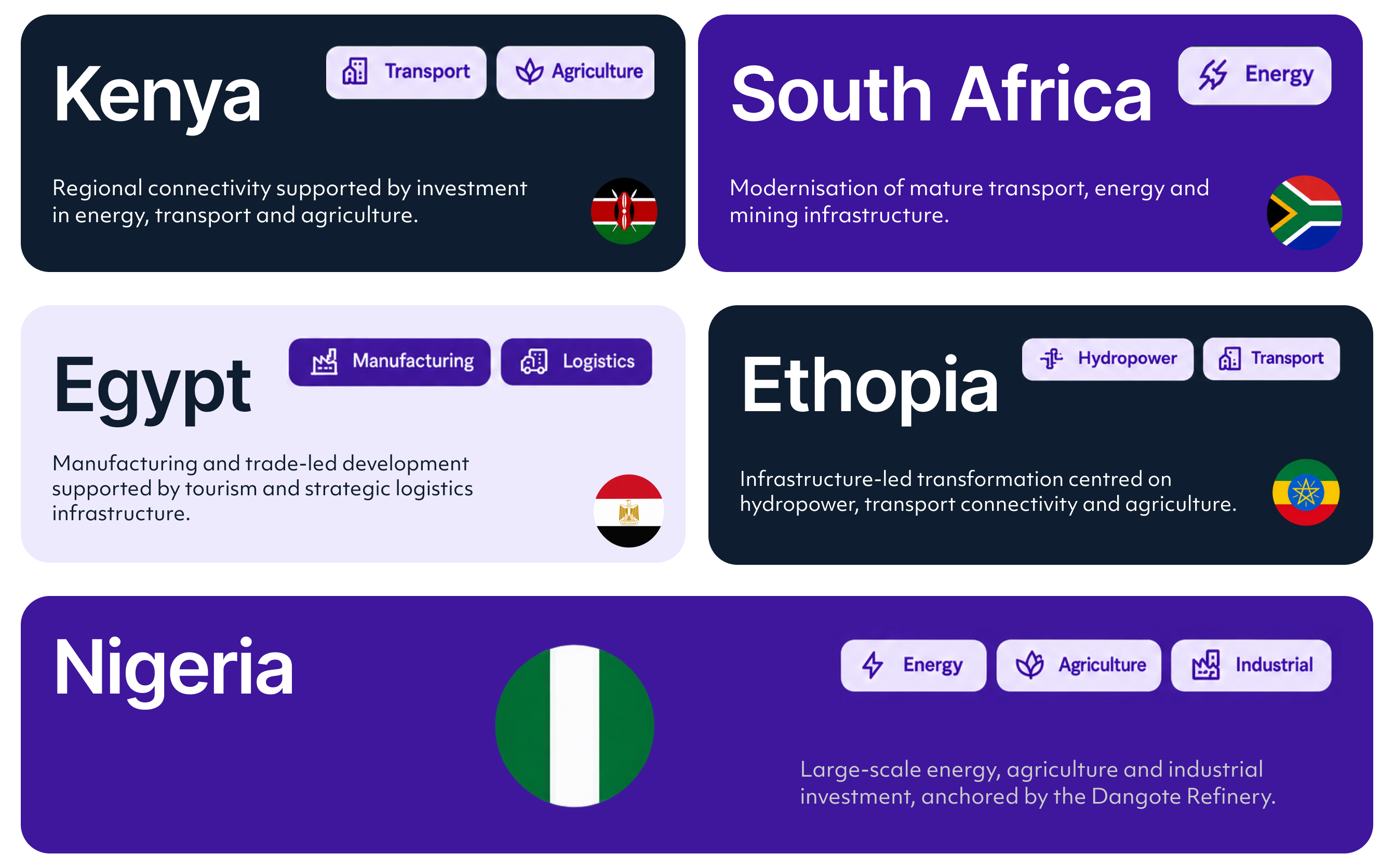
Together, these markets demonstrate how infrastructure investment is addressing different economic priorities, from improving regional connectivity and modernising established systems to expanding energy access, strengthening industrial capacity and increasing domestic value addition.
Africa's infrastructure needs remain substantial. According to the African Development Bank, the continent requires approximately US$130–170 billion annually in infrastructure investment, with an estimated financing gap of US$68–108 billion. This gap continues to constrain economic growth but also represents a significant opportunity for governments, development finance institutions and private investors.
Infrastructure priorities are increasingly interconnected. Investment in energy, transport and logistics, water, digital infrastructure and agriculture supports industrialisation, trade, food security and economic resilience. Regional initiatives such as Agenda 2063 and the African Continental Free Trade Area (AfCFTA) are reinforcing this approach by increasing demand for cross-border transport corridors, electricity interconnections and digital networks.
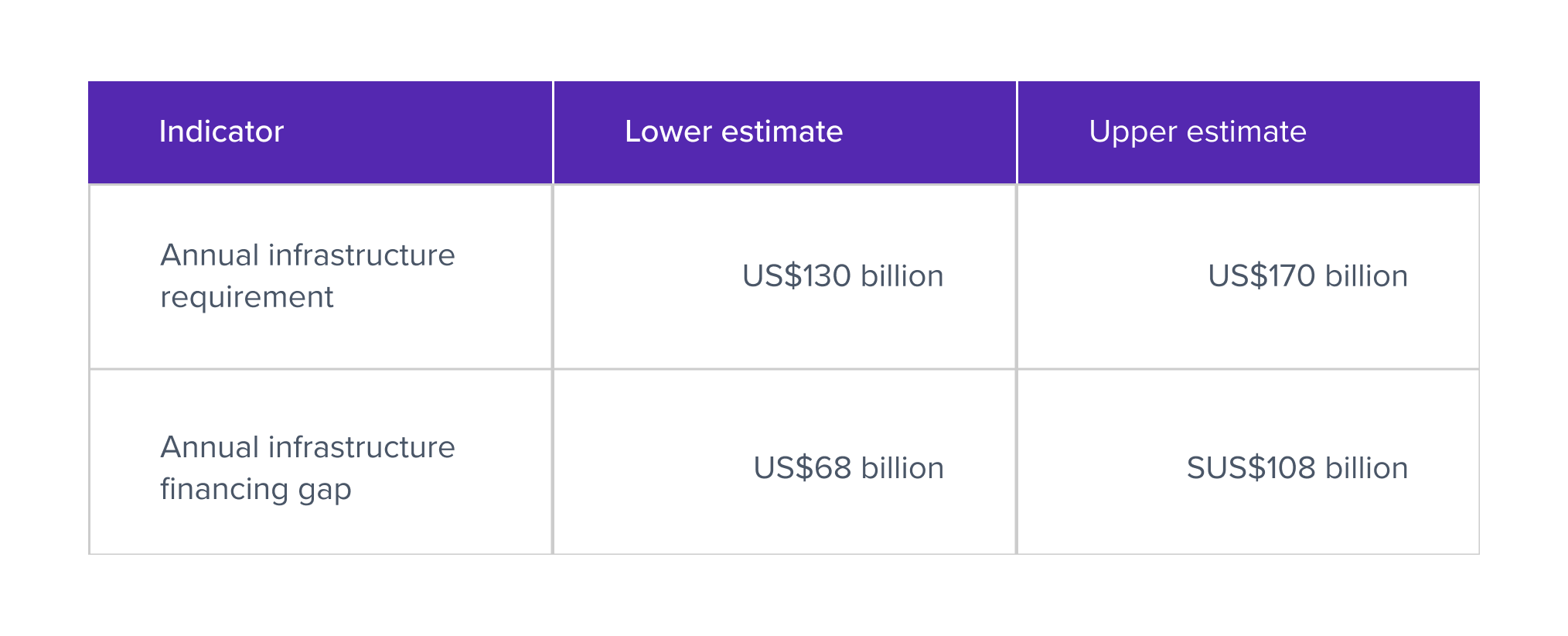
Insight: Africa requires approximately US$130–170 billion annually for infrastructure, leaving a financing gap of up to US$108 billion. Closing this gap will require greater mobilisation of public, development and private capital.
Sources: African Development Bank – President’s opening address at the 2026 Annual Meetings. Data visualization by Versus Africa.
Regional infrastructure is becoming particularly important as African economies seek to increase intra-continental trade. The Programme for Infrastructure Development in Africa (PIDA) coordinates major cross-border investments in transport, energy, ICT and water, helping connect markets and strengthen regional value chains.
.png)
Insight: PIDA's pipeline demonstrates the scale of coordinated infrastructure investment required to strengthen regional connectivity and support greater intra-African trade.
Sources: African Union – PIDA progress update, February 2026. Data visualization by Versus Africa.
Private capital will be increasingly important in delivering this investment. Fiscal constraints and rising public debt are encouraging greater use of public-private partnerships (PPPs), blended finance and other mechanisms that share project risks between governments, development institutions and investors.
However, financing alone will not close Africa's infrastructure gap. Projects continue to face high financing costs, regulatory uncertainty, foreign-exchange volatility, procurement delays and implementation constraints. Strengthening project preparation, governance and regulatory certainty will therefore be critical to converting Africa's infrastructure needs into bankable investment opportunities.
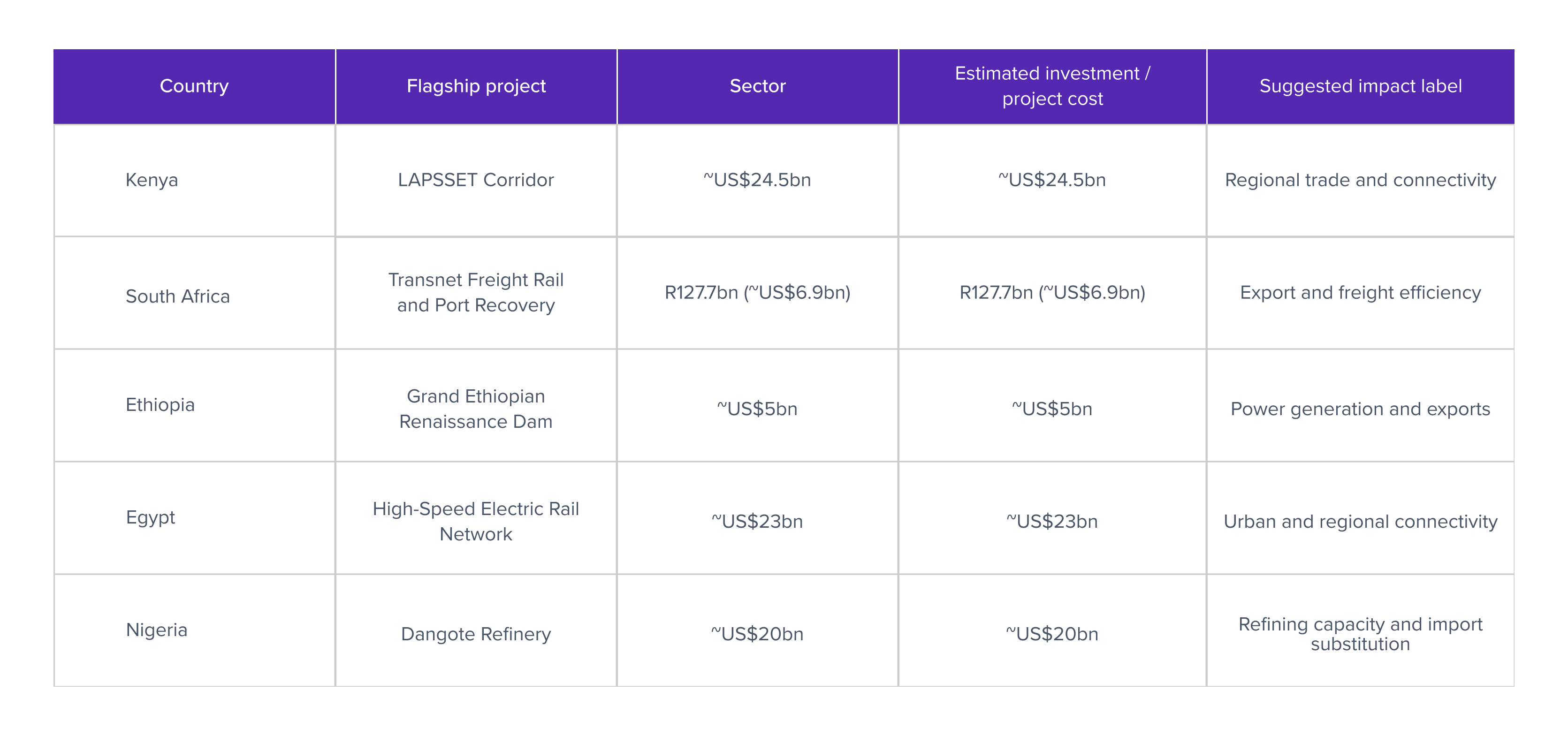
Insight: The five flagship projects represent infrastructure commitments of very different scales, from approximately US$5 billion for Ethiopia's GERD to more than US$20 billion each for LAPSSET, Egypt's high-speed rail network and the Dangote Refinery. Together, they illustrate the scale of capital being mobilised across Africa's transport, energy and industrial infrastructure. However, large project pipelines do not necessarily eliminate infrastructure financing gaps, particularly where investment requirements extend beyond individual flagship projects.
Sources: Kenya –LAPSSET Corridor, South Africa – Transnet Recovery Plan, Ethiopia – Grand Ethiopian Renaissance Dam, Egypt – National Authority for Tunnels, Nigeria – Dangote Refinery Data visualization by Versus Africa.
Kenya is one of East Africa's leading infrastructure markets and a key regional gateway for trade and logistics. Guided by Kenya Vision 2030 and the Bottom-Up Economic Transformation Agenda (BETA), infrastructure investment is focused on improving productive capacity, regional connectivity and economic competitiveness.
Three sectors are particularly important to this agenda: Energy, Transport & Logistics, and Agriculture. Together, they support electricity access, regional trade, food security and export growth while creating opportunities for public and private investment.
Kenya is one of Africa's leading renewable-energy markets, with geothermal, hydro, wind and solar providing most of its electricity generation. The Olkaria Geothermal Complex is central to this system, providing reliable baseload power and reducing dependence on imported fossil fuels. Continued investment in generation, transmission and grid infrastructure is expected to support electricity access and industrial growth.
Kenya's strategic location and access to the Indian Ocean make transport infrastructure critical to regional trade. The Port of Mombasa and Standard Gauge Railway (SGR) form the backbone of a logistics network connecting the coast with Nairobi and neighbouring landlocked markets.Large-scale initiatives such as the LAPSSET Corridor are intended to strengthen these connections further through integrated port, road, rail and logistics infrastructure, reinforcing Kenya's position as an East African trade gateway.
Agriculture remains central to Kenya's economy, with infrastructure investment focused on irrigation, rural roads, storage, cold-chain systems and agro-processing. Under the Agricultural Sector Transformation and Growth Strategy (ASTGS), these investments aim to improve productivity, reduce post-harvest losses and strengthen food security and export competitiveness.Expansion of irrigation and logistics infrastructure is particularly important for Kenya's horticulture and other high-value agricultural exports, where reliable storage and transport are essential for accessing international markets.
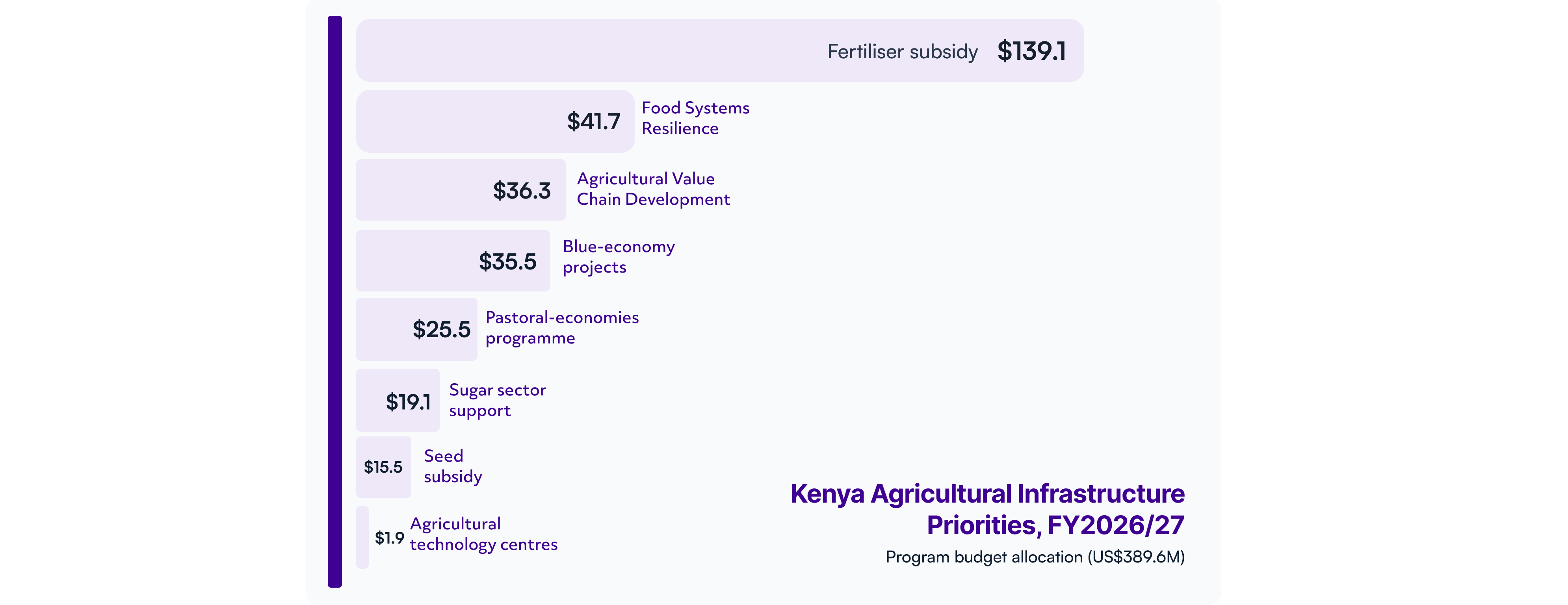
Insight: Kenya's agricultural infrastructure priorities emphasise irrigation, storage, value-chain development and market connectivity, reflecting the role of infrastructure in improving food security and agricultural productivity.
Sources:Kenya National Treasury – Mwananchi Guide for the FY2026/27 Budget., Kenya National Treasury – FY2026/27 Budget Summary. Data visualization by Versus Africa.
Kenya's infrastructure strategy combines renewable energy, regional transport connectivity and agricultural modernisation. Its role as East Africa's logistics gateway, together with continued investment in clean energy and agricultural value chains, creates opportunities across energy, logistics, agribusiness and trade.
As Africa's most industrialised economy, South Africa has one of the continent's most developed infrastructure networks. Its priority is increasingly the rehabilitation and modernisation of existing assets, particularly freight rail, ports and electricity infrastructure, where operational constraints have affected economic growth and export competitiveness.
Under the National Infrastructure Plan 2050, infrastructure investment is focused on improving logistics, energy security and industrial productivity while expanding private-sector participation. The country's infrastructure story is therefore centred on three interconnected sectors: Transport & Logistics, Energy, and Mining.
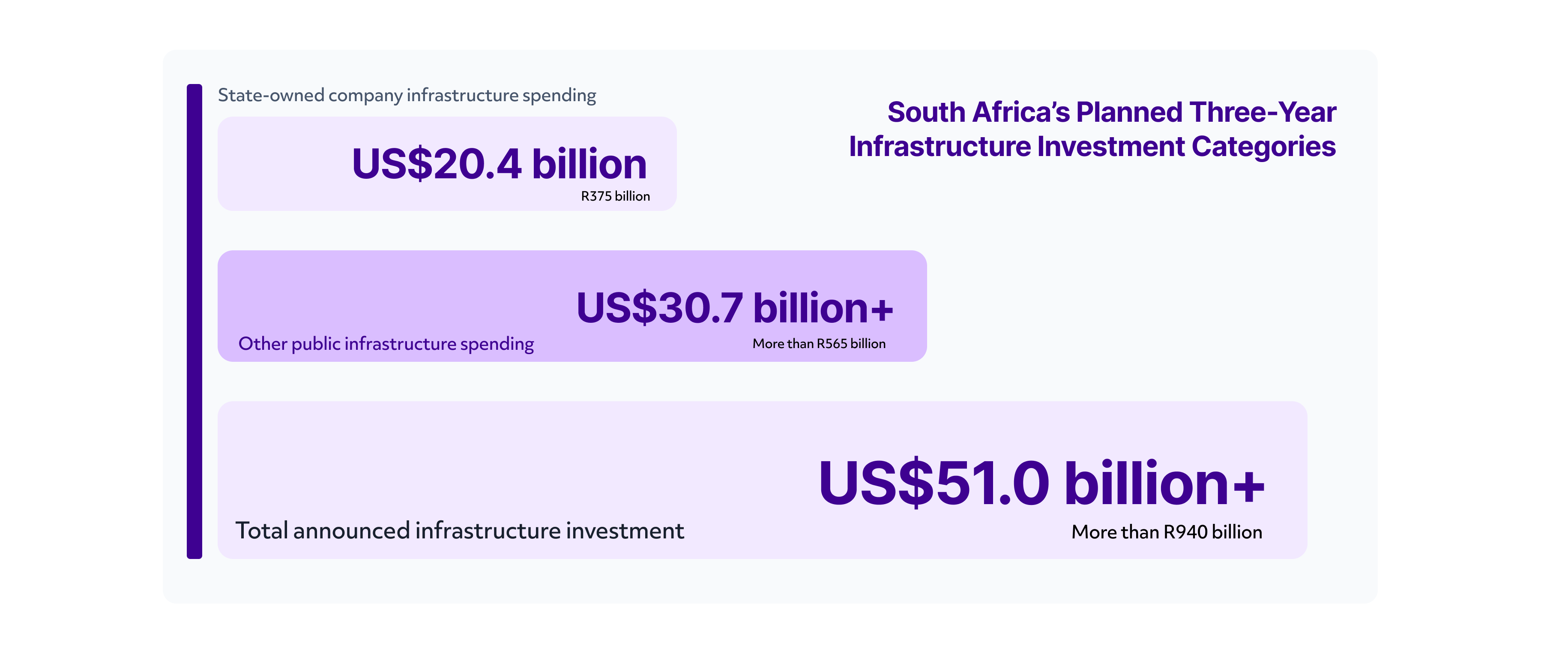
Insight: South Africa announced more than R940 billion (approximately US$51 billion) in infrastructure spending over three years, including R375 billion (approximately US$20.4 billion) by state-owned companies, with investment directed towards transport, water and energy infrastructure.
Sources: South African Government – SONA 2025 infrastructure highlights.Data visualization by Versus Africa.
South Africa's freight rail and port infrastructure is critical to mining, manufacturing, agriculture and regional trade. Through the Transnet Recovery Plan, investment is focused on restoring freight capacity, improving port performance and addressing logistics bottlenecks that have constrained exports.Modernisation of the ports of Durban, Richards Bay and Cape Town, alongside greater private-sector participation in freight rail, is expected to improve supply-chain efficiency and reinforce South Africa's role as Southern Africa's principal logistics gateway.
Reliable electricity remains one of South Africa's most important infrastructure priorities. Reforms under the Integrated Resource Plan (IRP) are expanding renewable generation, transmission capacity and battery storage while encouraging greater participation by independent power producers.The Renewable Energy Independent Power Producer Procurement Programme (REIPPPP) has attracted substantial private investment in wind and solar generation. Continued grid investment will be essential to connect new capacity and improve long-term electricity reliability.
Mining remains a major contributor to South Africa's economy and an important source of export earnings and employment. The sector's competitiveness depends heavily on reliable electricity, efficient freight rail and functioning ports, making infrastructure performance directly relevant to mineral production and exports.South Africa's reserves of platinum-group metals, manganese, chrome and other critical minerals also position the sector to benefit from growing global demand associated with renewable energy, batteries and electric vehicles.
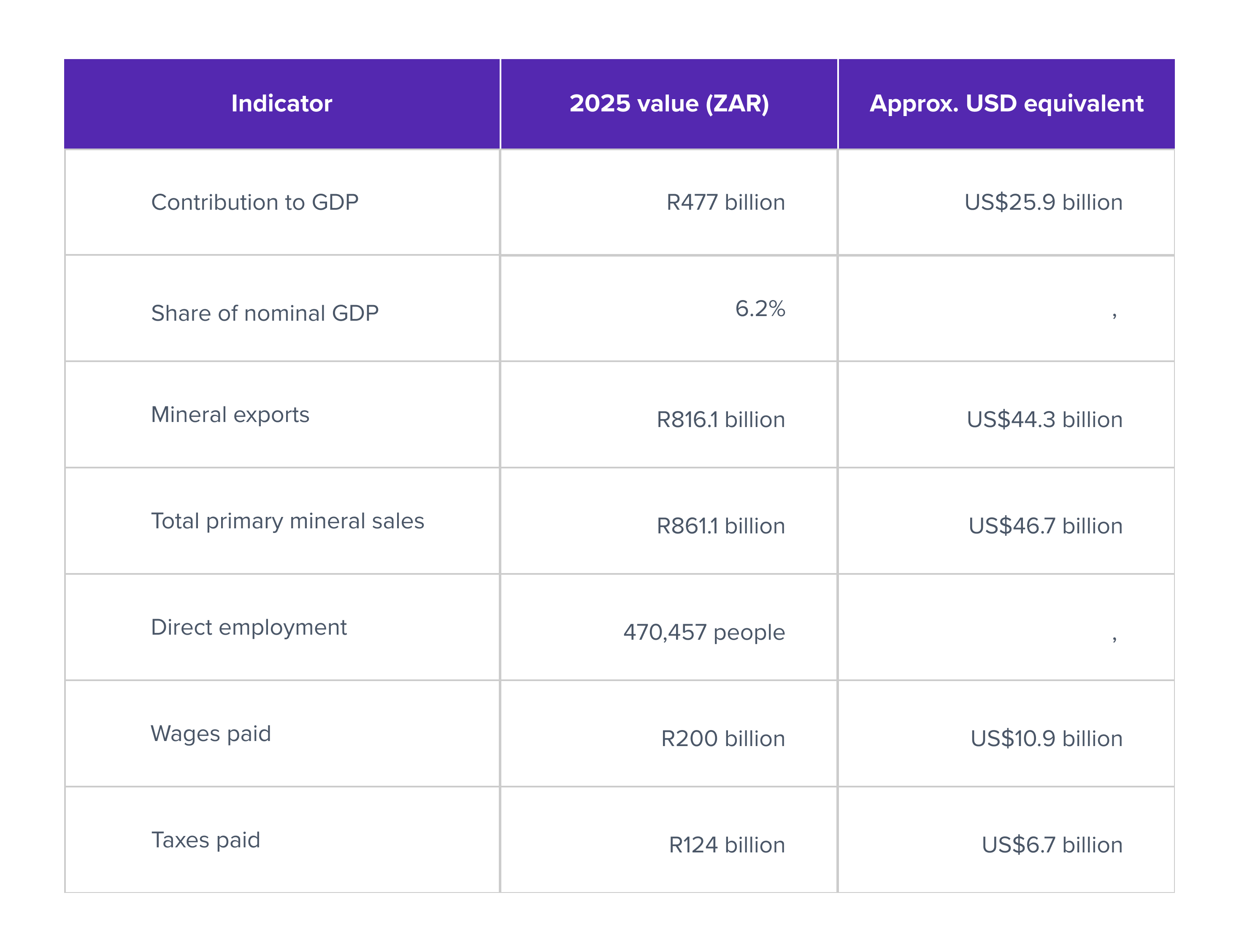
Insight: Mining remains a major contributor to South Africa's economy, contributing R477 billion (approximately US$25.9 billion) to GDP and generating R816.1 billion (approximately US$44.3 billion) in mineral exports in 2025, while driving demand for transport, logistics and energy infrastructure.
Sources: Minerals Council South Africa – 2025 Integrated Annual Review., Minerals Council – 2025 industry statement., Minerals Council – Facts & Figures 2025, SONA 2025 infrastructure highlights Data visualization by Versus Africa.
South Africa's infrastructure opportunity is centred less on building entirely new systems than on restoring and modernising existing ones. Improving freight logistics and electricity reliability will be critical to strengthening industrial productivity, mining exports and regional competitiveness while creating opportunities for greater private-sector investment.
Egypt's strategic position between Africa, Europe and Asia makes it an important regional manufacturing, tourism and logistics hub. Following recent economic pressures, infrastructure investment and reforms aimed at expanding private-sector participation have become important components of the country's growth strategy.
Under Egypt Vision 2030, investment in industrial zones, tourism infrastructure, ports and transport networks is supporting exports, foreign investment and foreign-currency generation. Three sectors illustrate this transformation particularly clearly: Manufacturing, Tourism, and Transport & Logistics.
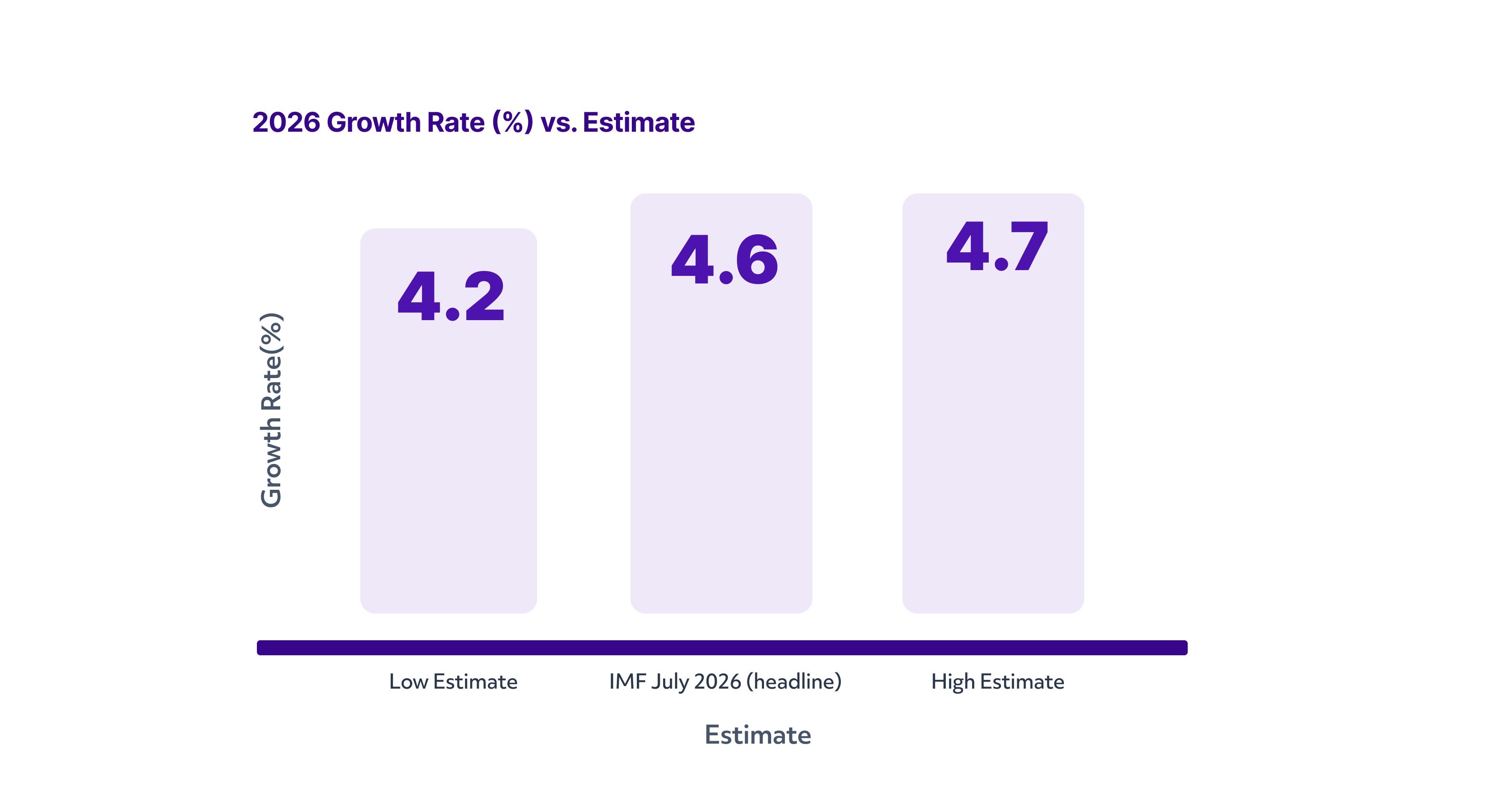
Insight: Egypt's 2026 growth outlook ranges from 4.2% to 4.7%, with the IMF's 4.6% forecast indicating improving economic momentum despite continued regional uncertainty.
Sources: EBRD – SCZone Economic Governance Case Study Data visualization by Versus Africa.
Manufacturing growth is increasingly concentrated around the Suez Canal Economic Zone (SCZone), where integrated ports, industrial zones and logistics infrastructure provide manufacturers with direct access to international markets. By early 2026, cumulative investment in the zone had reached approximately US$16 billion, with 205 factories operational and another 172 under construction.Chinese investment through the China-Egypt TEDA Suez Economic and Trade Cooperation Zone, alongside projects in automotive and rail manufacturing, is supporting Egypt's export-oriented industrial strategy. Continued growth will depend on expanding utilities and infrastructure as investor demand increases.
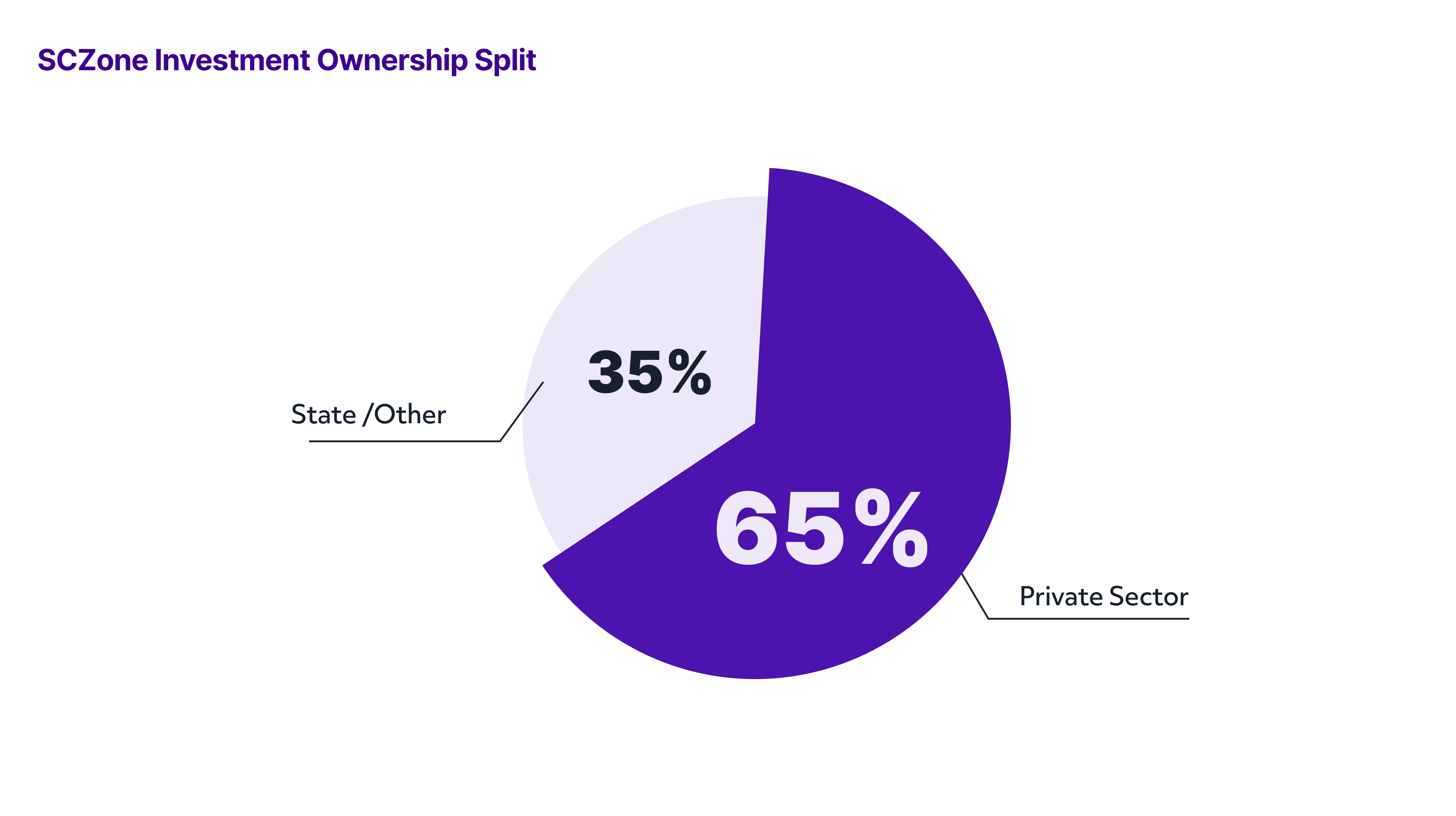
Insight: Private investors account for approximately 65% of SCZone investment, highlighting the increasing role of private capital in Egypt's industrial expansion.
Source: IMF's latest country assessment. Data visualization by Versus Africa.
Tourism is a major source of employment and foreign-currency earnings, supported by investment in hotels, airports, transport and cultural infrastructure. Egypt welcomed approximately 6.1 million international visitors in the first four months of 2026, reflecting continued growth in visitor demand.The Grand Egyptian Museum, fully opened in November 2025, is strengthening Egypt's tourism offering and stimulating additional hospitality investment. However, expanding accommodation capacity and managing exposure to regional instability remain important to sustaining growth.
The Suez Canal remains Egypt's most strategically important transport asset, normally carrying around 12% of global trade and connecting markets across Asia, Europe and Africa. Although Red Sea security disruptions have reduced traffic and foreign-currency earnings, the canal retains significant cost and distance advantages over alternative routes.Together with the SCZone's ports and logistics infrastructure, continued investment in railways and freight networks reinforces Egypt's position as a regional trade and manufacturing gateway.
Egypt's infrastructure story is defined by the relationship between manufacturing, tourism and international connectivity. Private investment in industrial development, growing tourism demand and the strategic importance of the Suez Canal are strengthening the country's role as a manufacturing, logistics and tourism hub, although regional instability remains an important risk.
Ethiopia has used large-scale infrastructure investment to support economic transformation despite the logistical constraints of being landlocked. Under its Ten-Year Development Plan (2021–2030), investment in energy, transport and agriculture is intended to expand productive capacity, improve regional connectivity and strengthen exports.
The country's infrastructure strategy is particularly visible across three interconnected sectors: Energy, Transport & Logistics, and Agriculture. Hydropower is expanding generation capacity, rail infrastructure is improving access to international markets through Djibouti, and agricultural investment is supporting Ethiopia's export economy.
Hydropower is central to Ethiopia's infrastructure strategy. The Grand Ethiopian Renaissance Dam (GERD) has substantially expanded the country's electricity-generation potential, supporting domestic energy security while creating opportunities for regional electricity exports.Investment in transmission and electrification, including the National Electrification Program (NEP 2.0), complements large-scale generation by extending electricity access to households and businesses. The challenge is increasingly not only generating additional power, but ensuring that transmission and distribution capacity keeps pace.
As a landlocked country, Ethiopia depends heavily on efficient connections to neighbouring ports. The Addis Ababa–Djibouti Railway provides a strategic freight corridor linking production centres with the Port of Djibouti, through which most of Ethiopia's international trade passes.Rail cargo volumes have increased as utilisation of the corridor has improved, while continued investment in roads and logistics hubs is intended to reduce transport costs and strengthen connections between agricultural and industrial production centres and export markets.
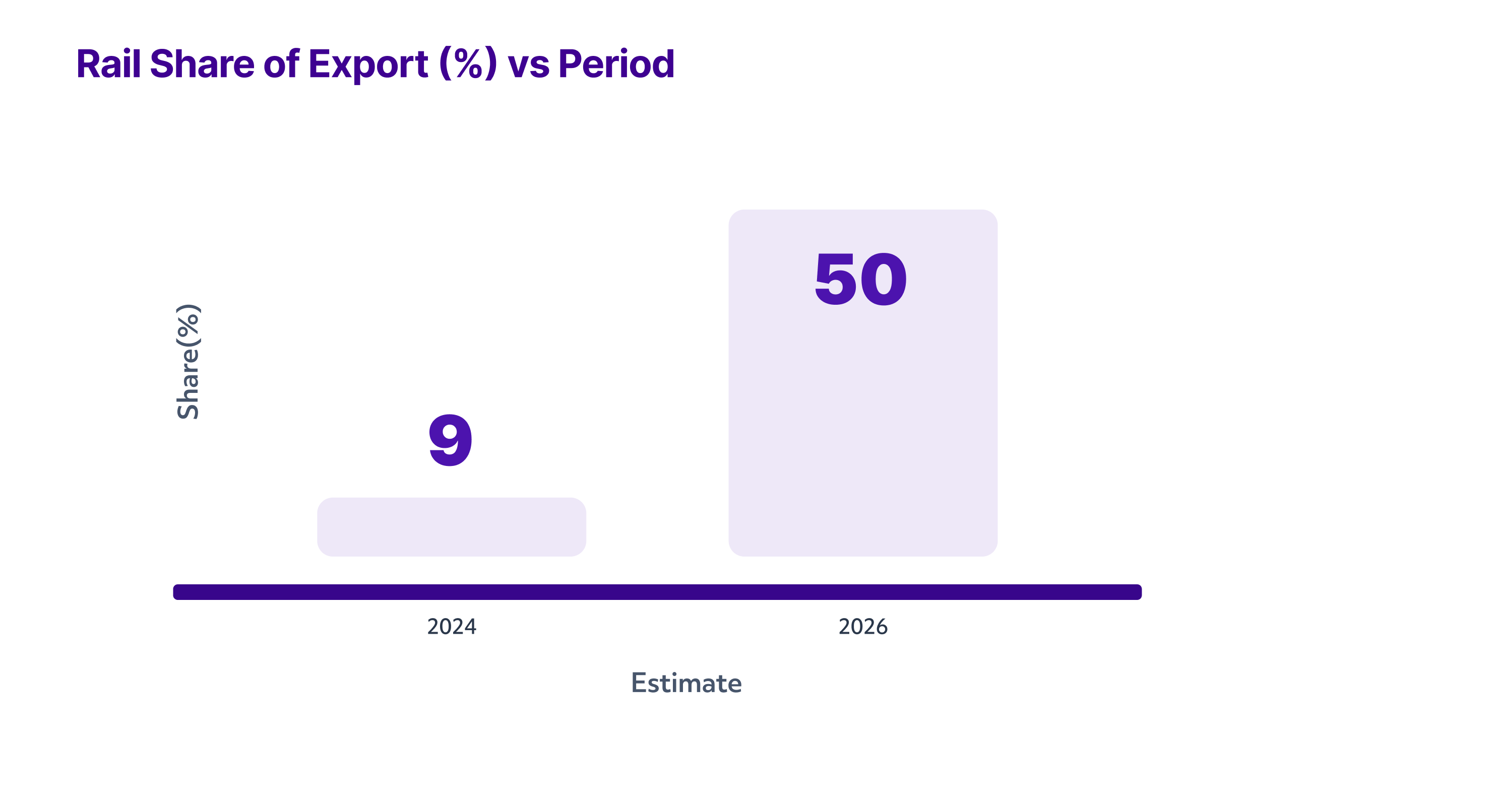
Insight: Rail's share of Ethiopia's export freight increased from approximately 9% in 2024 to 50% in 2026, demonstrating the growing role of the Addis Ababa–Djibouti Railway in the country's export logistics.
Source: IMF's latest country assessment. Data visualization by Versus Africa.
Agriculture remains central to Ethiopia's economy and export earnings, with coffee providing a particularly important link between agricultural production and infrastructure. Coffee export earnings reached approximately US$3 billion in 2025/26, up from US$2.65 billion the previous year.Investment in processing, storage and logistics, including the Sabata Logistics Hub, can improve market access and help producers capture greater value from agricultural exports. However, ageing coffee trees and continuing fuel, container and logistics constraints demonstrate the importance of connecting agricultural investment with wider transport infrastructure.
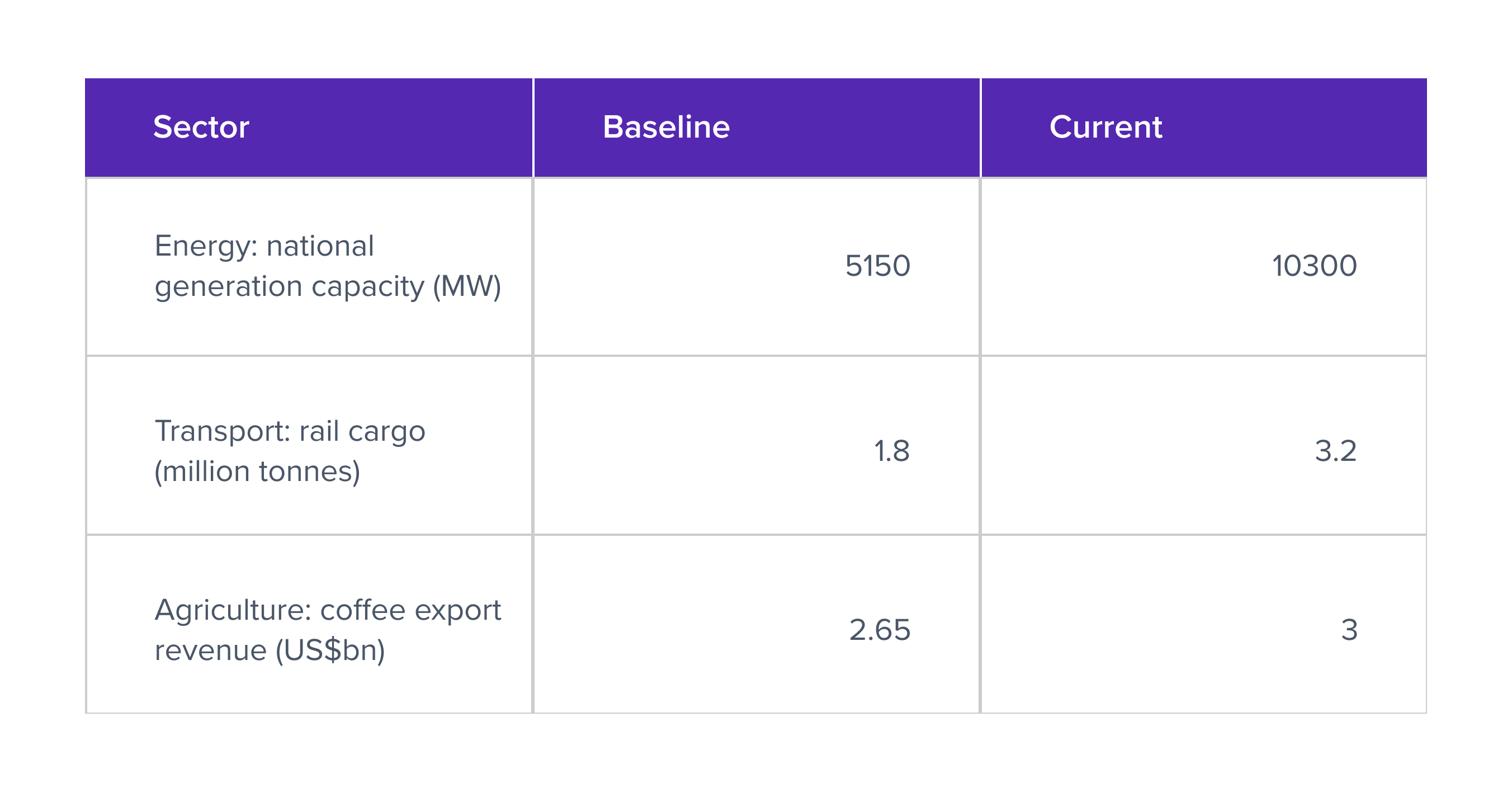
Insight: Ethiopia has recorded growth across all three priority sectors: generation capacity has doubled, rail cargo has increased substantially, and coffee export earnings have reached US$3 billion. Together, the figures illustrate how energy, transport and agriculture are contributing to expanded productive and export capacity.
Sources: Water Power Magazine / Prospect (energy); Kana TV (rail); ENA / 2merkato (coffee) Data visualization by Versus Africa.
Ethiopia's infrastructure story demonstrates the interdependence of power, logistics and agriculture. Expanded electricity generation, growing rail utilisation and record coffee exports are strengthening productive capacity, but transmission and logistics bottlenecks remain important constraints on fully realising these investments.
Nigeria's scale, population and natural-resource base make it one of Africa's most significant infrastructure markets. Investment is critical to addressing energy constraints, strengthening domestic production and supporting economic diversification, while persistent infrastructure gaps continue to limit productivity and competitiveness.
Three sectors are particularly important to this agenda: Oil & Gas, Agriculture, and Power & Energy Infrastructure. Together, they reflect Nigeria's efforts to strengthen energy security, improve food systems and expand industrial capacity through regulatory reform and greater private-sector participation.
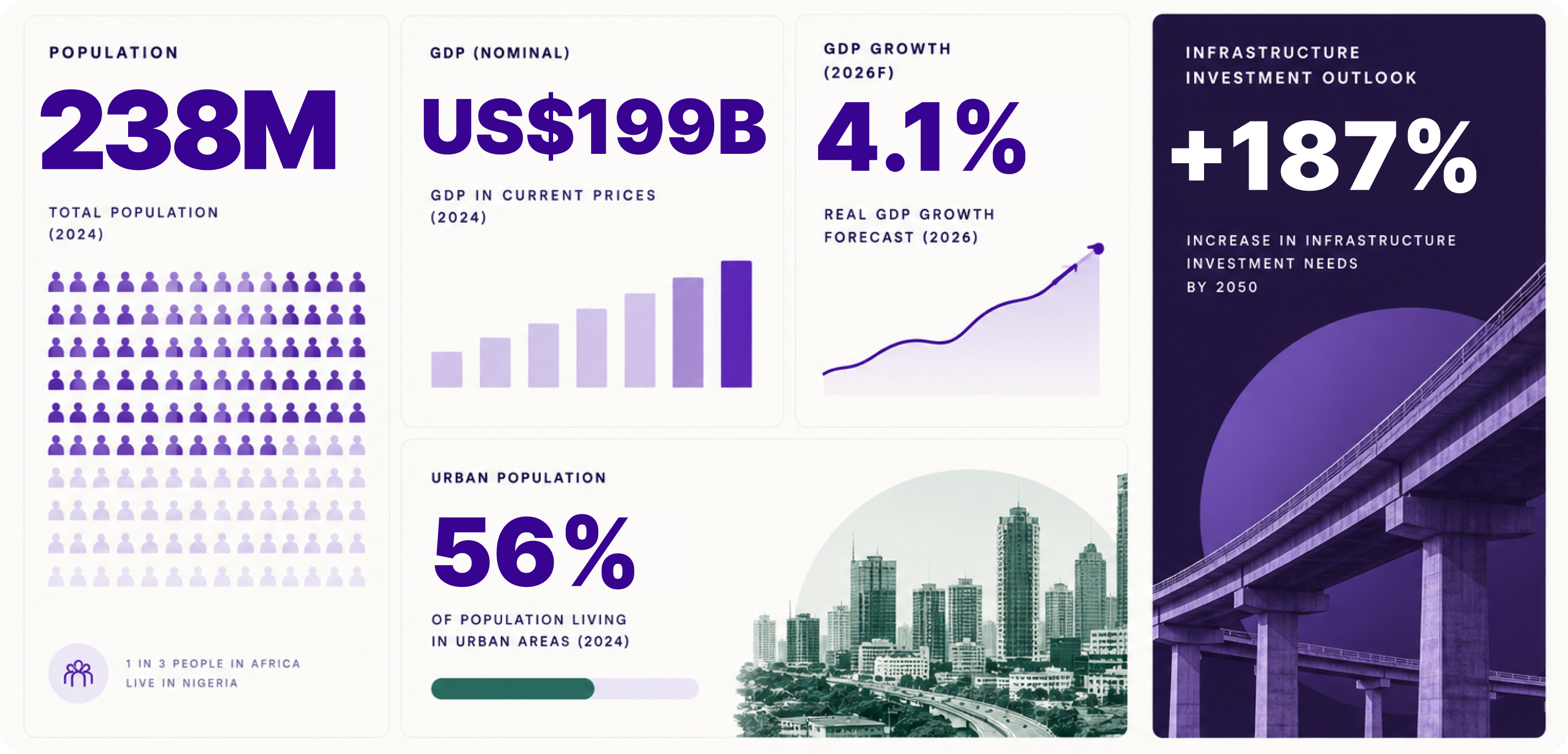
Sources: World Bank Data; International Monetary Fund (IMF) 2026 Article IV Consultation Data visualization by Versus Africa.
Oil and gas remain central to Nigeria's economy and export earnings. The Petroleum Industry Act (PIA), renewed investment in deepwater assets and greater emphasis on gas commercialisation are reshaping the sector, while Nigeria's substantial crude oil and natural gas reserves provide a foundation for continued investment.Major projects including the Ajaokuta–Kaduna–Kano (AKK) Gas Pipeline, Bonga North and expanded domestic refining capacity are intended to strengthen gas utilisation, energy security and local value addition. However, ageing infrastructure, crude supply constraints, oil theft and financing challenges continue to affect sector performance.
.png)
Insight: Nigeria’s oil production recovered from 1.38 million barrels per day in 2022 to 1.64 million in 2025, marking three consecutive years of improvement, although output remained below its 2020 level. The recovery highlights improving production alongside the continued need for upstream infrastructure investment.
Sources: U.S. Energy Information Administration (EIA), National Bureau of Statistics (NBS) GDP Report Q4 2024. Data visualization by Versus Africa.
Agriculture remains one of Nigeria's largest employers and a key component of economic diversification. Infrastructure investment is increasingly focused on irrigation, storage, rural connectivity, processing and agricultural value chains.The Special Agro-Industrial Processing Zones (SAPZ) programme illustrates this shift by linking production areas with processing and market infrastructure. Continued investment could reduce post-harvest losses, strengthen food security and increase domestic value addition, although logistics, climate risks and limited access to finance remain important constraints.
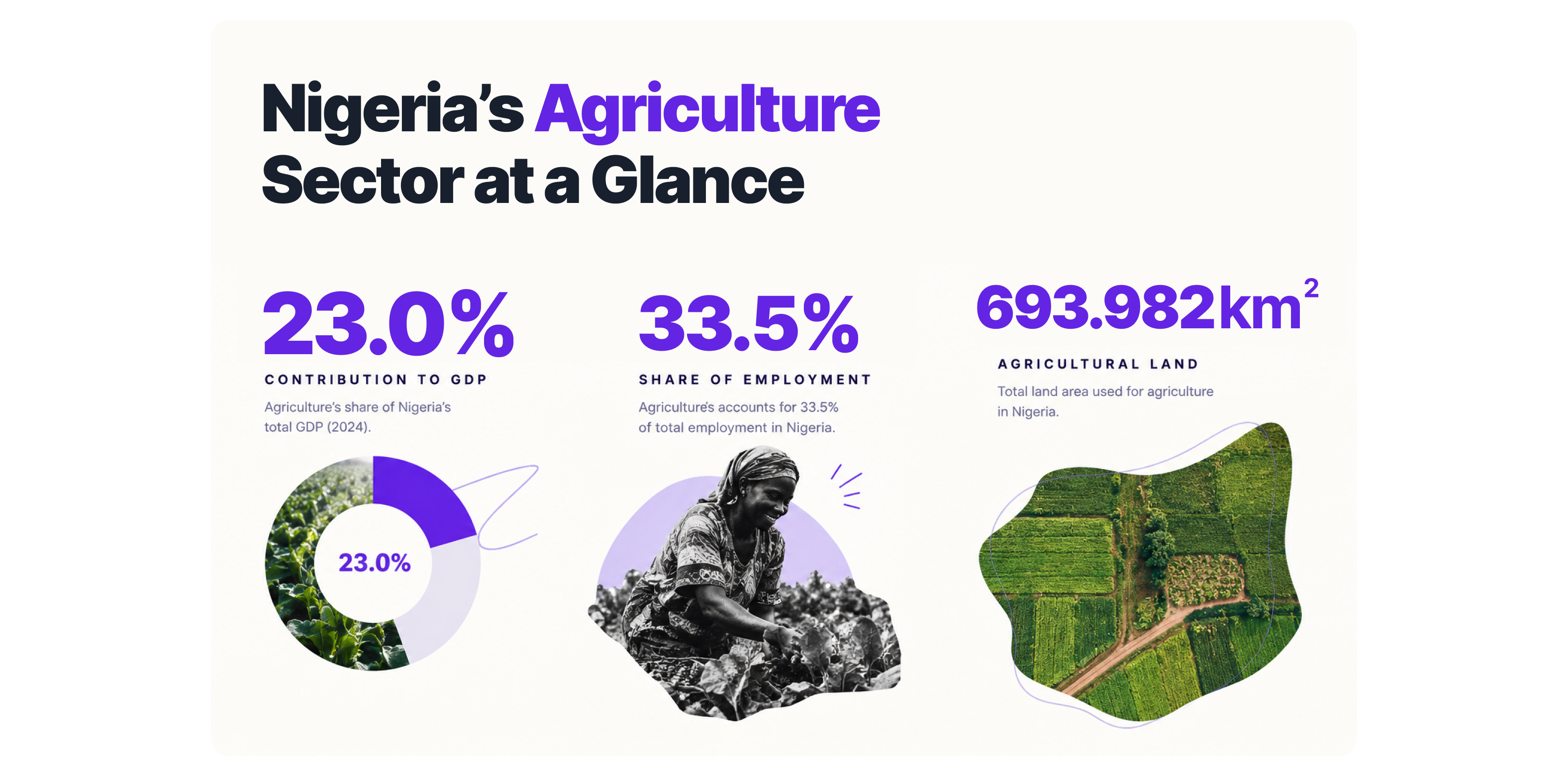
Sources: World Bank World Development Indicators, International Labour Organization (ILO) Modelled Estimates Data visualization by Versus Africa.
Reliable electricity remains one of Nigeria's most significant infrastructure challenges and investment opportunities. Generation constraints, transmission bottlenecks and distribution losses continue to affect households and businesses, increasing reliance on alternative power sources.Initiatives including the Presidential Power Initiative, Nigeria Energy Transition Plan and Rural Electrification Agency programmes are expanding transmission, renewable energy and distributed electricity solutions. Investment opportunities remain significant across grid infrastructure, gas-to-power, renewables, mini-grids and metering.
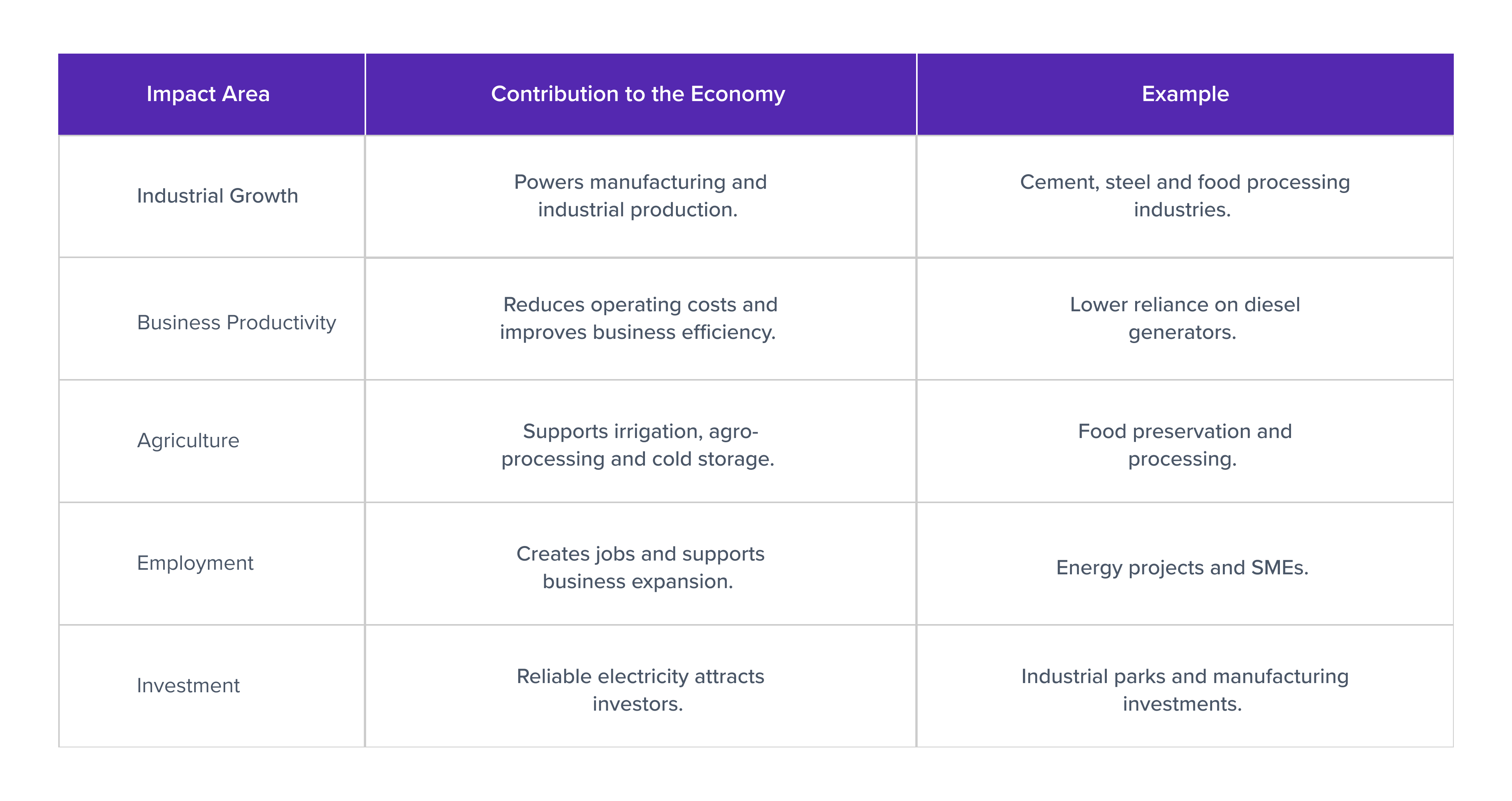
Insight: Reliable electricity has economy-wide implications for Nigeria, supporting industrial production, agriculture, employment and investment while reducing businesses' dependence on costly alternative power sources.
Sources: International Energy Agency (IEA) – Nigeria Energy Profile; World Bank – Nigeria Overview; Nigerian Electricity Regulatory Commission (NERC) Reports Data visualization by Versus Africa.
Nigeria's infrastructure opportunity is defined by both scale and unmet demand. Investment in oil and gas, agriculture and power can strengthen domestic production, improve energy and food security and support economic diversification. The scale of these opportunities is particularly visible in the Dangote Refinery, which provides the report's central case study of private infrastructure-led industrial development.
The Dangote Petroleum Refinery, located in the Lekki Free Zone near Lagos, is one of Africa's largest privately financed industrial projects. With capacity to process approximately 700,000 barrels of crude oil per day, the refinery was developed to expand Nigeria's domestic refining capacity, reduce dependence on imported petroleum products and strengthen energy security.The approximately US$20 billion project combines refining with supporting port, storage, pipeline, power and logistics infrastructure. This integrated model allows the refinery's economic influence to extend beyond petroleum into transport, manufacturing, logistics and regional trade.
.png)
Data Sources: Dangote Petroleum Refinery, Reuters – Nigeria's Dangote refinery tops 700,000 barrels a day in test. Data visualization by Versus Africa.
The refinery's significance extends beyond its scale. Increased domestic refining can reduce Nigeria's reliance on imported fuel and support foreign-exchange savings, while creating demand across logistics, engineering, maintenance and downstream industries.Its location within the Lekki Free Zone, alongside port and industrial infrastructure, also positions the refinery to serve regional markets. Increased refining capacity could strengthen fuel supply across West Africa and support greater intra-African trade under the African Continental Free Trade Area (AfCFTA).However, long-term performance will depend on reliable crude supply, supporting transport and storage infrastructure, regulatory stability and the ability to manage exchange-rate and global oil-price volatility.
The Dangote Refinery demonstrates how large-scale private infrastructure can combine industrial capacity with ports, logistics, energy and trade infrastructure to generate wider economic effects. Its next phase, from operational performance to a potential public listing, will provide an important test of whether Africa's largest privately financed industrial projects can translate physical infrastructure into sustained economic and investment value.
The Dangote Refinery's significance extends beyond Nigeria's petroleum sector. Its scale and integrated infrastructure demonstrate how major private investment can influence industrial development, regional trade and infrastructure financing. Four broader lessons emerge from the project.
The refinery combines processing capacity with port, storage, pipeline, power and logistics infrastructure. This demonstrates how coordinated infrastructure can generate wider economic benefits than isolated assets by connecting production directly with supporting services and markets.
Processing crude oil domestically rather than relying heavily on imported refined products illustrates the potential for infrastructure to strengthen local value chains. Similar approaches across agriculture, mining and manufacturing could support industrialisation, employment and export diversification.
Africa's infrastructure requirements cannot be met through public financing alone. The Dangote Refinery demonstrates the potential for large-scale private investment to complement government and development-finance programmes, particularly where projects can generate sustainable commercial returns.
The refinery's potential to supply refined products beyond Nigeria illustrates how nationally located infrastructure can have regional effects. Combined with the African Continental Free Trade Area (AfCFTA), investments in production, transport and logistics could strengthen intra-African supply chains and reduce dependence on imports from outside the continent.
With commercial operations underway, the Dangote Refinery is entering a new phase with its Initial Public Offering (IPO). Nigeria’s Securities and Exchange Commission (SEC) has approved the offering, which is scheduled to open on September 14, 2026 and close on October 13, 2026. The offer is expected to raise approximately ₦2.15 trillion (US$1.6 billion) through the sale of 4.1 billion ordinary shares at ₦525 per share, potentially making it Africa’s largest-ever IPO.The offering marks a significant transition for one of Africa’s largest privately financed industrial assets, opening participation to a broader base of investors while raising capital to support the refinery’s expansion plans. The company is expected to list on the Nigerian Exchange (NGX) in November 2026, extending the refinery’s significance beyond energy and industrial development into Africa’s capital markets.
Note: Egypt was excluded, as the survey focused on African markets expected to participate in the IPO via local exchanges.
Question: Have you heard that the Dangote Refinery is planning or considering an IPO (initial public offering / listing shares on the stock exchange)?
.png)
Source: Versus Africa survey via Versus Ask. Base: All Respondents (N=600) | Nigeria (n=202) | Kenya (n=100) | South Africa (n=100) | Ghana (n=50) | Ethiopia (n=50) | Côte d’Ivoire (n=50). Survey participation across all countries were done from July 21st - July 29th 2026.
Insight: Awareness of the proposed Dangote Refinery IPO was strongest in Nigeria, where respondents were the most likely to report having heard a lot about the offering. Kenya and Côte d'Ivoire also recorded relatively high levels of awareness, while Ghana and Ethiopia had the largest share of respondents hearing about the IPO for the first time. South Africa stood out for its balanced distribution, with respondents almost evenly split between high awareness, limited awareness, and no prior awareness. These findings suggest that awareness-building efforts may need to be more targeted in markets where familiarity with the IPO remains relatively low. Among respondents who were aware of the proposed Dangote Refinery IPO, the survey also explored the primary channels through which they first heard about the offering.
Note: Egypt was excluded, as the survey focused on African markets expected to participate in the IPO via local exchanges.
Question: Where did you hear about it? Have you heard that the Dangote Refinery is planning or considering an IPO (initial public offering / listing shares on the stock exchange)?
.png)
Source:Versus Africa survey via Versus Ask. Base: Filtered By: Respondents aware of the proposed Dangote Refinery IPO | Nigeria (n=155) | Kenya (n=79) | South Africa (n=60) | Ghana (n=24) | Ethiopia (n=27) | Côte d’Ivoire (n=35). Percentages are based on respondents in each market. Survey participation across all countries were done from July 21st - July 29th 2026.
Insight: Social media was the leading source of awareness about the proposed Dangote Refinery IPO across all surveyed markets. Online news platforms also played an important role, especially in South Africa and Kenya, while traditional media such as TV and radio remained a secondary source of information across the region. Nigeria and South Africa stood out for having relatively stronger word-of-mouth awareness, whereas financial advisors and brokers played only a limited role in shaping awareness across all six markets. These findings suggest that digital channels are the primary drivers of IPO awareness across Africa, highlighting the importance of social media and online news platforms in investor engagement. Awareness of the proposed Dangote Refinery IPO does not necessarily translate into investment interest. To better understand potential investor sentiment, respondents were asked whether they would consider investing in the IPO if given the opportunity. The visual below presents the findings across the six surveyed markets.
Note: Egypt was excluded, as the survey focused on African markets expected to participate in the IPO via local exchanges.
Question: If the Dangote Refinery IPO becomes available, how likely would you be to invest?
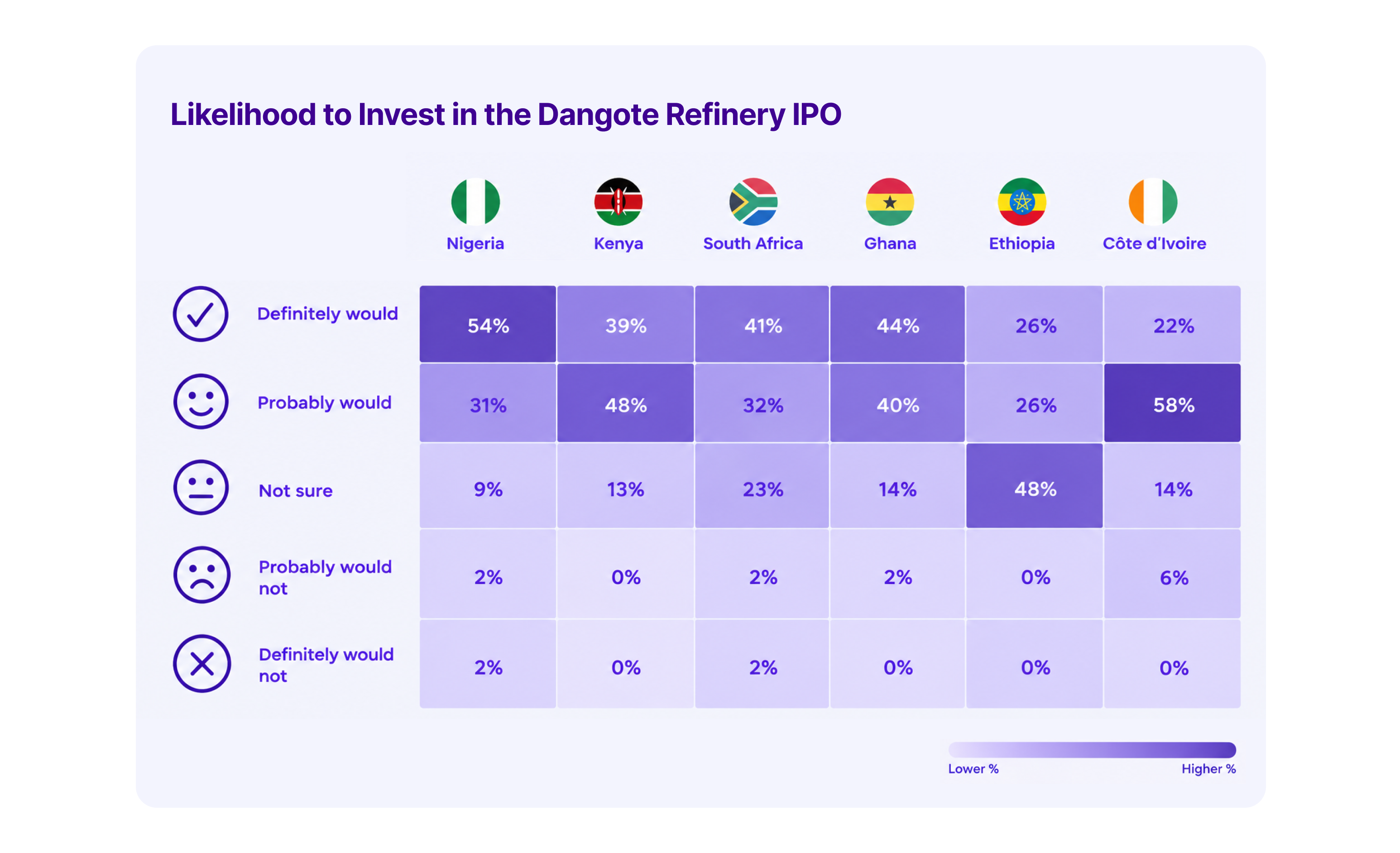
Source: Versus Africa survey via Versus Ask. Base: All Respondents (N=600) | Nigeria (n=202) | Kenya (n=100) | South Africa (n=100) | Ghana (n=50) | Ethiopia (n=50) | Côte d’Ivoire (n=50) Percentages are based on respondents in each market. Survey participation across all countries were done from July 21st - July 29th 2026.
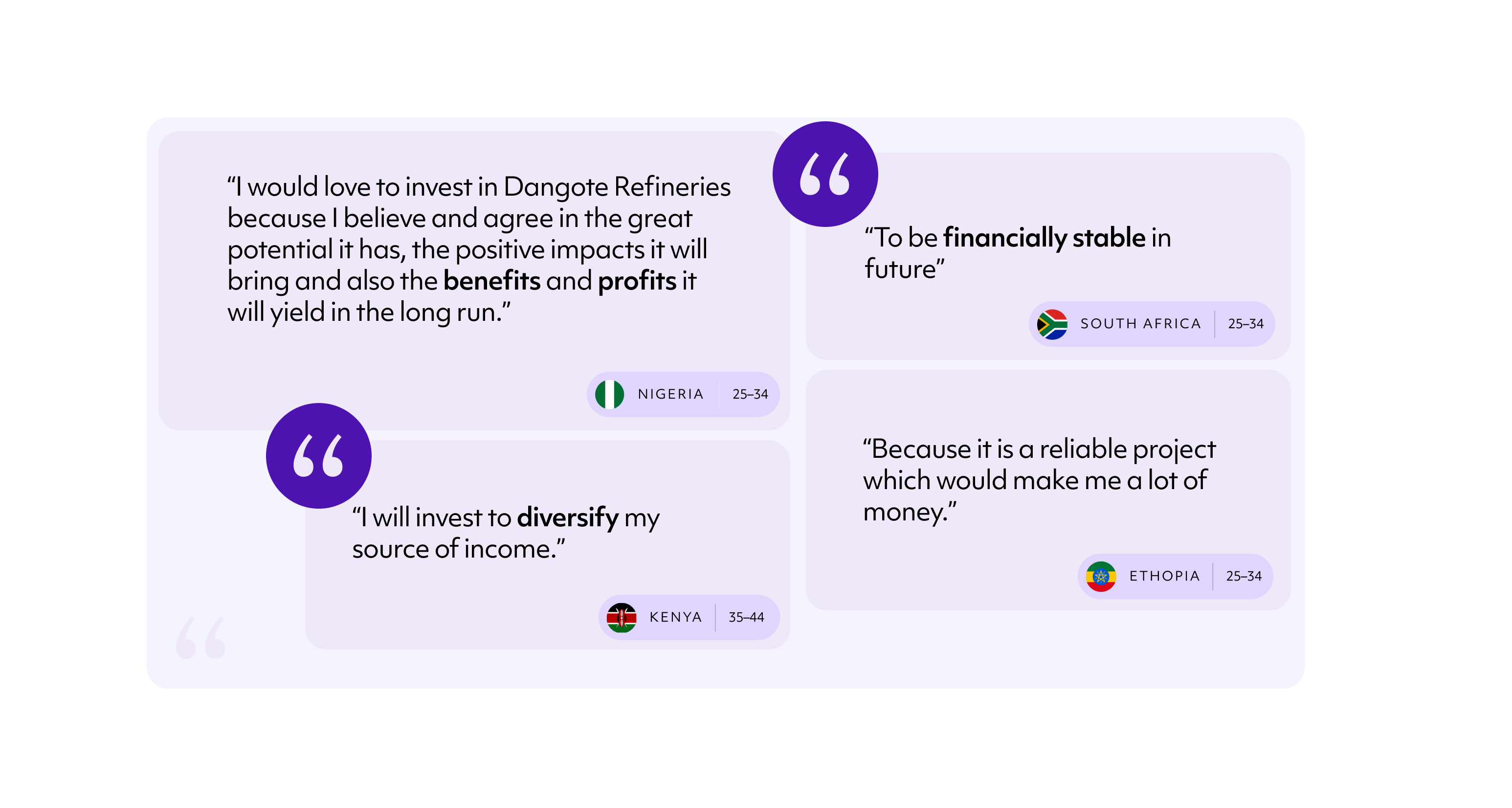
Insight: The proposed Dangote Refinery IPO generated strong interest across the surveyed markets. Nigeria recorded the strongest investment intent, while Kenya and Côte d'Ivoire also showed high levels of willingness to invest. Ethiopia stood out for having the highest level of uncertainty, suggesting that additional awareness and investor education may be needed to convert interest into actual participation. Overall, the findings indicate that the IPO has the potential to attract investors across the region, although market readiness differs from country to country. While the survey findings indicate a strong willingness to invest in the proposed Dangote Refinery IPO across the surveyed markets, respondents were also asked to explain the reasons behind their investment intentions in their own words. The responses reveal that the decision to invest is driven primarily by expectations of attractive financial returns, long-term wealth creation, future financial security, and confidence in the refinery's growth potential. Many respondents also expressed trust in the Dangote brand and viewed the IPO as a unique opportunity to own a stake in one of Africa's most significant industrial projects. Selected responses are presented below to provide further insight into the motivations underlying respondents' investment intentions.
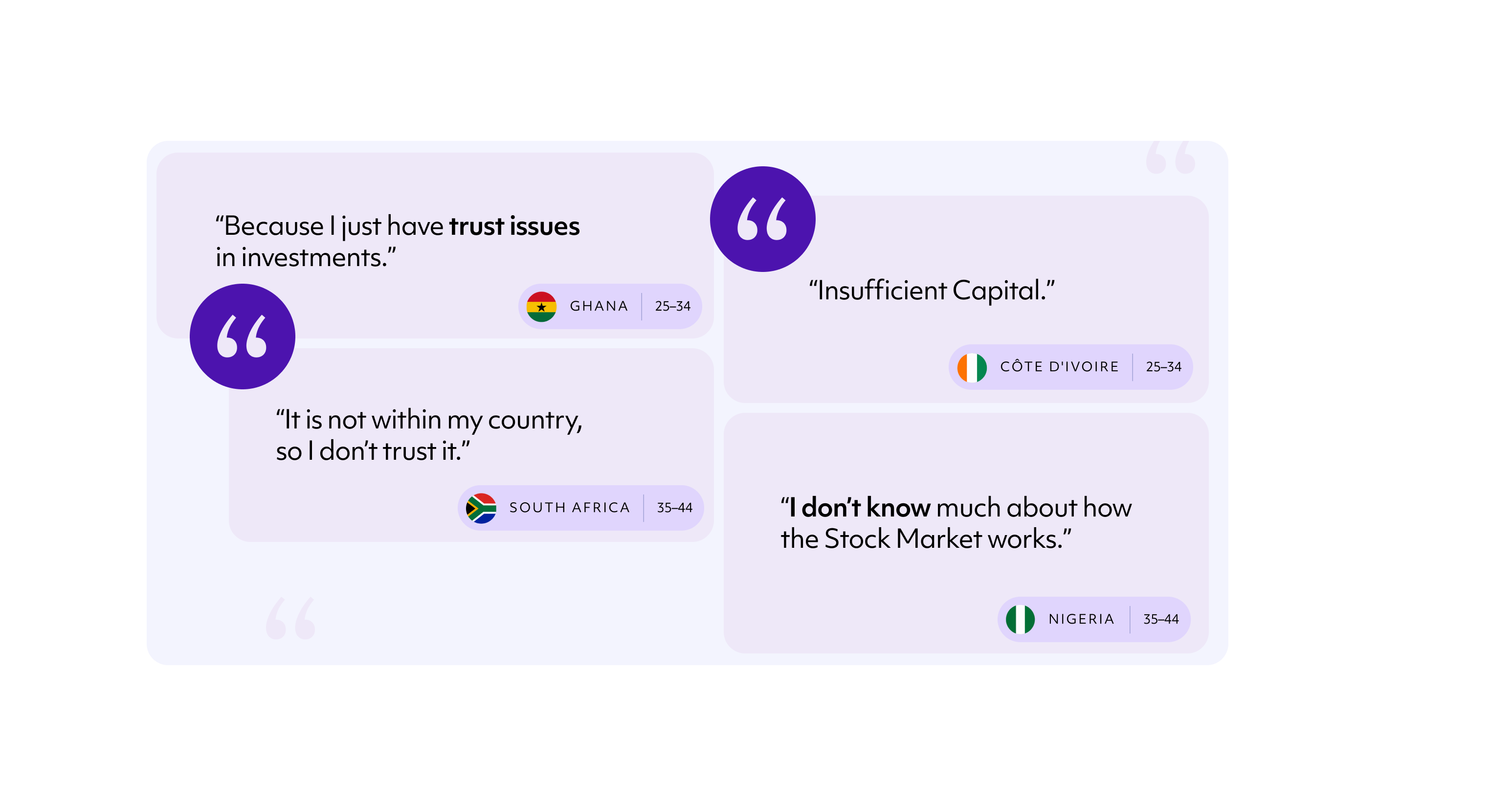
While many respondents expressed an interest in investing in the proposed Dangote Refinery IPO, others indicated that they were either uncertain or would not consider investing. The most common reasons cited were limited financial capacity, insufficient knowledge about the IPO or stock market investing, and concerns about investment risk and uncertainty. Some respondents also indicated that they would require more information before making an investment decision. Selected responses are presented below.
Note: Egypt was excluded, as the survey focused on African markets expected to participate in the IPO via local exchanges.
Question: Which of these would matter most to your decision to invest in something like the Dangote IPO?
.png)
Source: Versus Africa survey via Versus Ask. Base: All Respondents (N=600) | Nigeria (n=202) | Kenya (n=100) | South Africa (n=100) | Ghana (n=50) | Ethiopia (n=50) | Côte d’Ivoire (n=50) Percentages are based on respondents in each market. Survey participation across all countries were done from July 21st - July 29th 2026.
Insight: Respondents across most markets placed the greatest importance on expected returns and the company's track record when considering whether to invest in the proposed IPO. Nigeria, Kenya and Ghana recorded particularly strong emphasis on these factors. Ethiopia presented a different pattern, with respondents placing greater importance on the share price and minimum investment amount. This suggests that investment decisions are driven primarily by confidence in the opportunity, although affordability remains a key consideration in some markets.
Note: Egypt was excluded, as the survey focused on African markets expected to participate in the IPO via local exchanges.
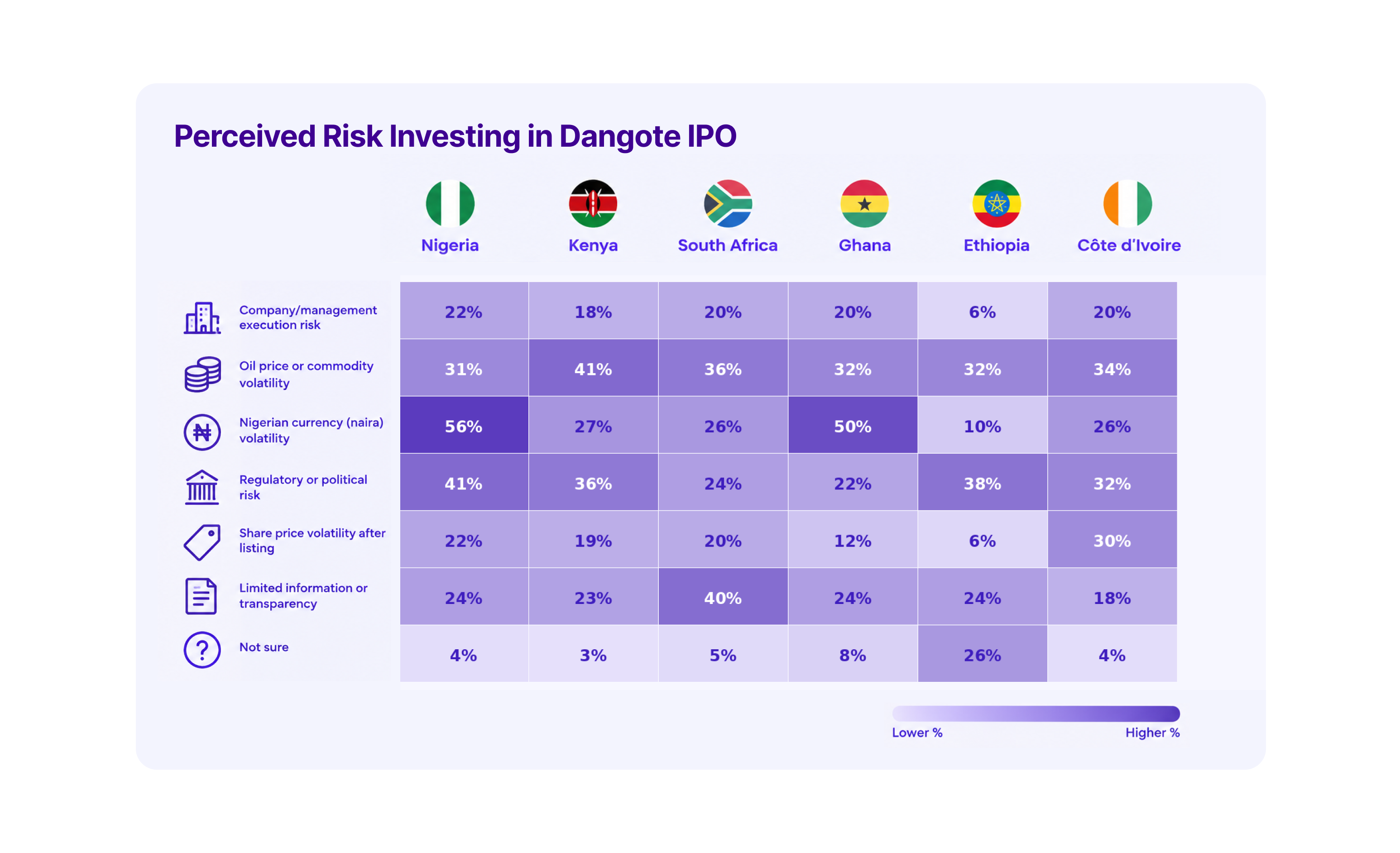
Question: What do you see as the biggest risk in investing in the Dangote IPO?
Source: Versus Africa survey via Versus Ask. Base: All Respondents (N=600) | Nigeria (n=202) | Kenya (n=100) | South Africa (n=100) | Ghana (n=50) | Ethiopia (n=50) | Côte d’Ivoire (n=50) Percentages are based on respondents in each market. Survey participation across all countries were done from July 21st - July 29th 2026.
Insight: Concerns about oil price volatility featured prominently across most surveyed markets, particularly in Kenya and South Africa. Nigeria stood out for its high level of concern about naira volatility, while South Africa recorded the highest concern about limited information and transparency. Ethiopia showed comparatively lower concern across most risk factors, although regulatory and political risk remained an important consideration. This suggests that investors assess IPO risks through the lens of their local market conditions, highlighting the need for market-specific communication and risk mitigation strategies.
Note: Egypt was excluded, as the survey focused on African markets expected to participate in the IPO via local exchanges.
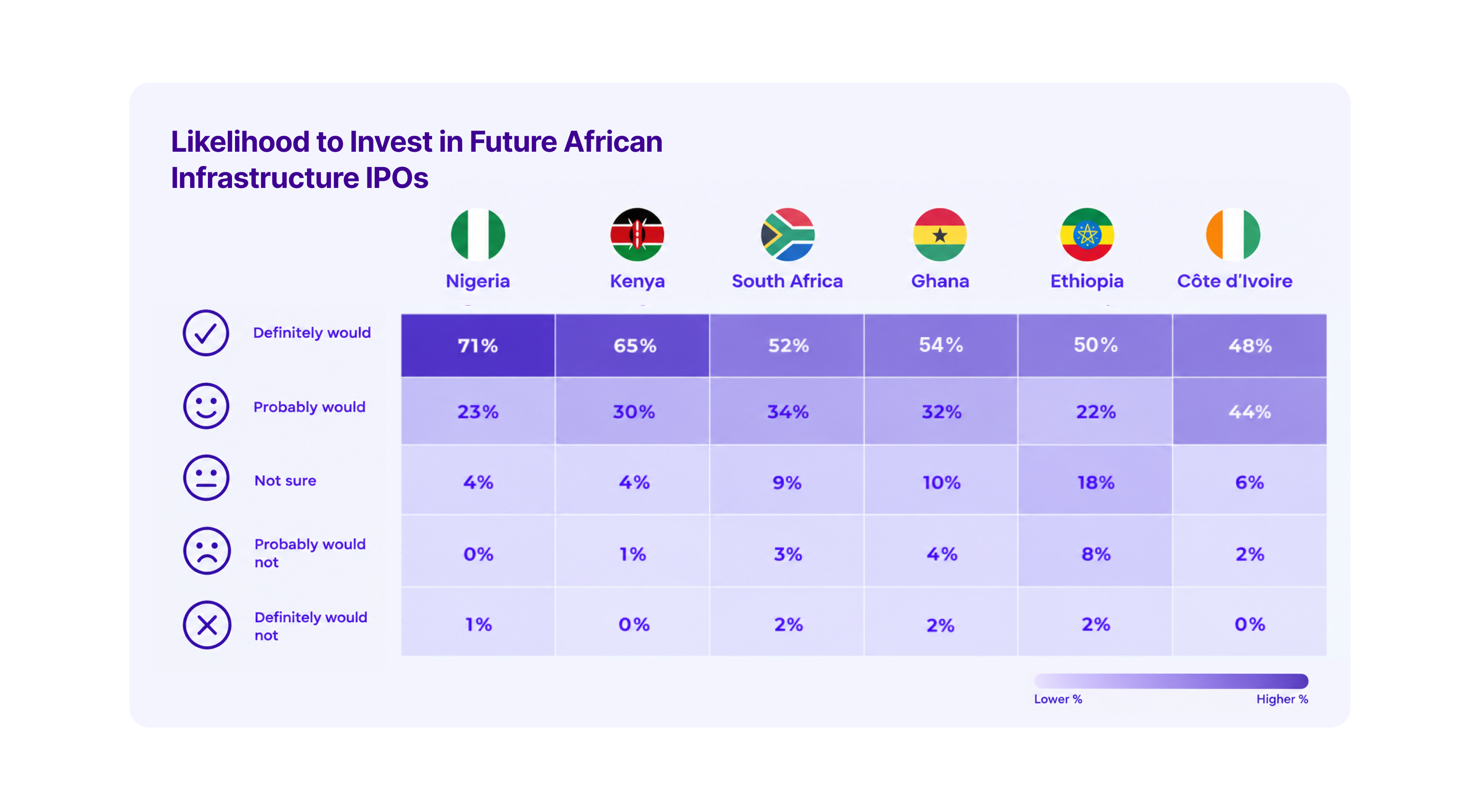
Question: If the Dangote IPO performs well, how likely would you be to invest in future African infrastructure IPOs (e.g. energy, transport, telecoms)?
Source: Versus Africa survey via Versus Ask. Base: All Respondents (N=600) | Nigeria (n=202) | Kenya (n=100) | South Africa (n=100) | Ghana (n=50) | Ethiopia (n=50) | Côte d’Ivoire (n=50) Percentages are based on respondents in each market. Survey participation across all countries were done from July 21st - July 29th 2026.
Insight: A successful Dangote Refinery IPO would increase interest in future African infrastructure IPOs across all surveyed markets. Nigeria and Kenya recorded the strongest intention to invest again, while South Africa, Ghana and Côte d'Ivoire also showed strong levels of interest. Ethiopia stood out for having the highest level of uncertainty, although most respondents still indicated they would consider investing. This suggests that a successful Dangote IPO could strengthen investor confidence and create broader interest in future infrastructure investment opportunities across the continent.
Public discussion around the refinery has shifted from construction costs and delays towards operational performance, crude supply, exports and domestic fuel pricing. The refinery's entry into international refined-product markets has reinforced its potential role as a regional supplier, while domestic debates continue around crude availability, foreign exchange and whether increased refining capacity will translate into sustainably lower fuel costs.This evolving narrative demonstrates that the refinery's long-term impact will depend not only on its physical capacity, but also on how effectively it operates within Nigeria's broader energy, regulatory and financial environment.
The Dangote Refinery demonstrates that infrastructure's impact depends not only on the size of an individual project, but on how effectively it connects capital, production, logistics and markets. Its broader lesson for Africa is the value of integrated infrastructure that strengthens domestic productive capacity while creating opportunities for regional trade and private investment.
While the preceding sections examined Africa's infrastructure landscape and the significance of the Dangote Refinery through secondary research, this section presents findings from a cross-market survey conducted to understand how these developments are perceived across selected African markets. The research explores public awareness of the Dangote Refinery, attitudes towards infrastructure investment, investment behaviour, and the factors influencing investment decisions.
The survey gathered responses from 600 participants across six African markets: Nigeria, Kenya, South Africa, Ghana, Ethiopia and Côte d'Ivoire. While Egypt was included in the broader infrastructure analysis, it was not part of the consumer survey, which focused on markets expected to participate in the IPO via local exchanges. The findings provide a comparative view of awareness of the Dangote Refinery, interest in infrastructure investment, and perceived barriers to investment, and the role of landmark projects in shaping investment sentiment across the continent.
Note: Egypt was excluded, as the survey focused on African markets expected to participate in the IPO via local exchanges.
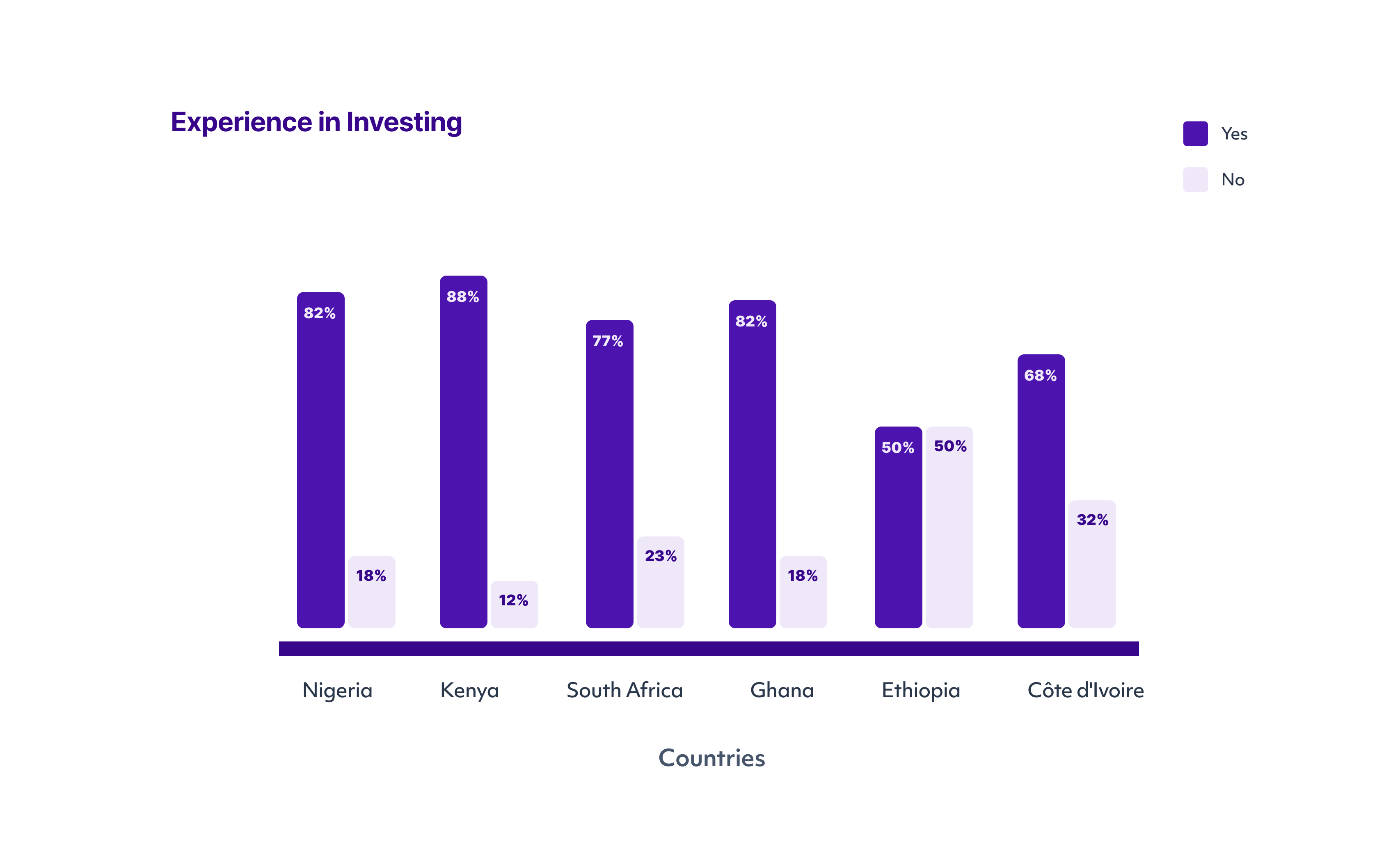
Question: Do you have experience in investing?
Source: Versus Africa survey via Versus Ask. Base: All Respondents (N=600) | Nigeria (n=202) | Kenya (n=100) | South Africa (n=100) | Ghana (n=50) | Ethiopia (n=50) | Côte d’Ivoire (n=50) Percentages are based on respondents in each market. Survey participation across all countries were done from July 21st - July 29th 2026.
Insight: Awareness of the proposed Dangote Refinery IPO was generally high across the surveyed markets, indicating strong regional visibility of the offering. However, awareness varied by country, suggesting that targeted communication and investor education may be required in markets where familiarity remains comparatively lower.
Note: Egypt was excluded, as the survey focused on African markets expected to participate in the IPO via local exchanges.
Question: Which of these do you invest in?
.png)
Source: Versus Africa survey via Versus Ask. Base: Filtered By: Respondents who have experience in investing | Nigeria (n=165) | Kenya (n=88) | South Africa (n=77) | Ghana (n=41) | Ethiopia (n=25) | Côte d’Ivoire (n=34). Percentages are based on respondents in each market. Survey participation across all countries were done from July 21st - July 29th 2026.
Insight: Stock market investments were the most common type of investment across all six markets, particularly in Kenya, Côte d'Ivoire and Nigeria. Fixed deposits were also popular, especially in Ghana, South Africa, Nigeria and Kenya. South Africa recorded higher participation in private equity and real estate investments, while Ethiopia stood out for its relatively stronger interest in bonds and private equity. This suggests that although stock market investments are common across the surveyed markets, investment preferences differ from one country to another.
Note: Egypt was excluded, as the survey focused on African markets expected to participate in the IPO via local exchanges.
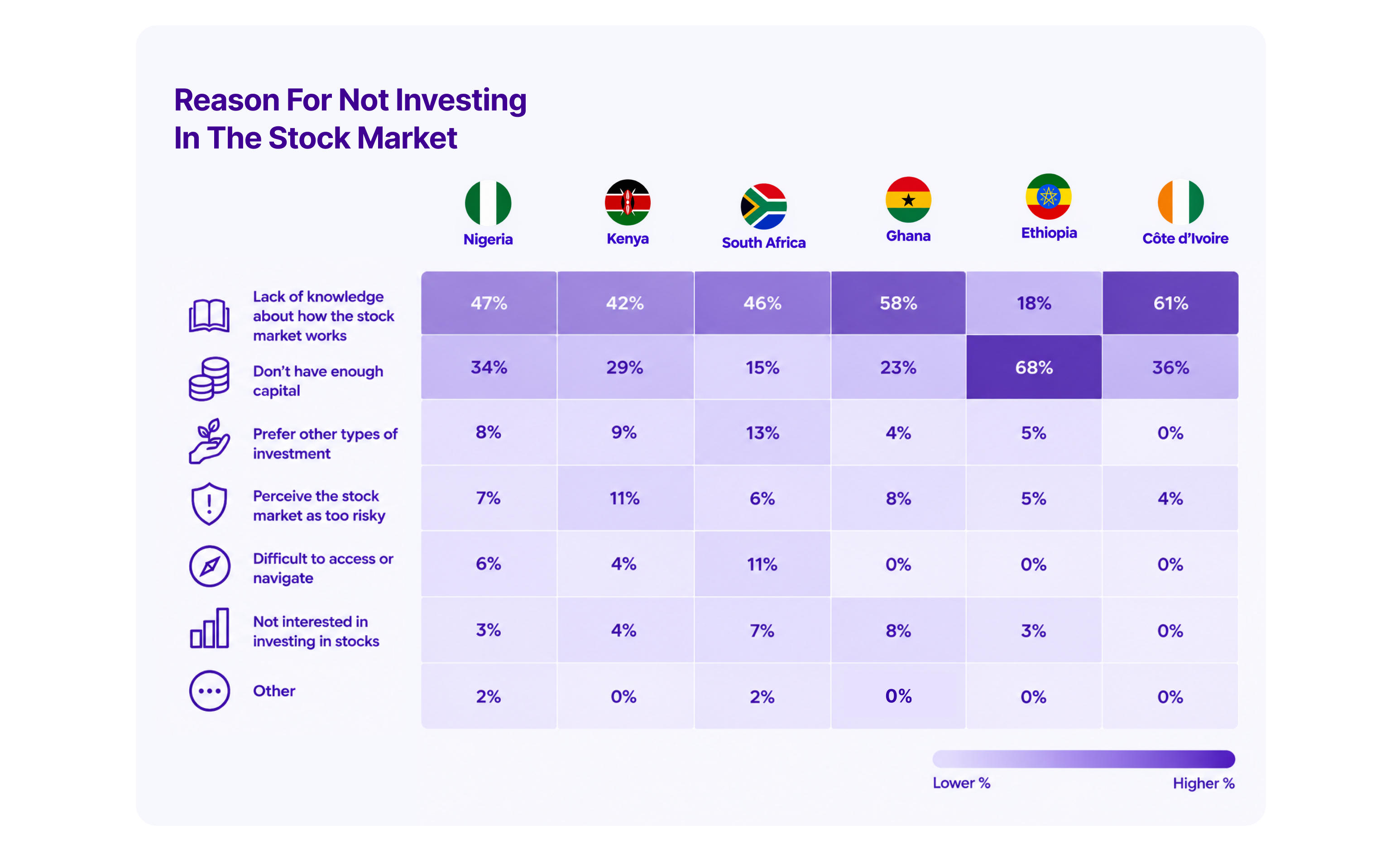
Question: Why do you not currently invest in the stock market?
Source: Versus Africa survey via Versus Ask. Base: Filtered By: Respondents who do not currently invest in the stock market | Nigeria (n=87) | Kenya (n=45) | South Africa (n=54) | Ghana (n=26) | Ethiopia (n=38) | Côte d’Ivoire (n=28). Percentages are based on respondents in each market. Survey participation across all countries were done from July 21st - July 29th 2026.
Insight: Limited understanding of how the stock market works was the main reason many respondents had not invested, particularly in Côte d'Ivoire, Ghana and Nigeria. Ethiopia stood out, with most respondents saying they did not have enough capital to invest. South Africa recorded relatively more respondents who cited difficulties accessing the stock market and a preference for other investment options. This suggests that the main barriers to investing differ across markets, with financial literacy, affordability and market access all influencing investment participation.
Note: Egypt was excluded, as the survey focused on African markets expected to participate in the IPO via local exchanges.
Question: Beyond the Dangote Refinery specifically, how interested are you in investing in African infrastructure projects generally (energy, transport, agriculture, etc.)?
.png)
Source: Versus Africa survey via Versus Ask. Base: All Respondents (N=600) | Nigeria (n=202) | Kenya (n=100) | South Africa (n=100) | Ghana (n=50) | Ethiopia (n=50) | Côte d’Ivoire (n=50). Percentages are based on respondents in each market. Survey participation across all countries were done from July 21st - July 29th 2026.
Insight: Interest in investing in African infrastructure projects was high across all six markets. Kenya, Côte d'Ivoire and Nigeria recorded the strongest levels of interest, while Ethiopia showed comparatively lower levels of enthusiasm and the highest proportion of respondents who were not interested. This suggests that there is a strong foundation for expanding retail participation in infrastructure investments across the region, although some markets may require greater awareness and investor engagement to stimulate demand.
Note: Egypt was excluded, as the survey focused on African markets expected to participate in the IPO via local exchanges.
Question: Which African infrastructure sectors do you find most attractive for investment?
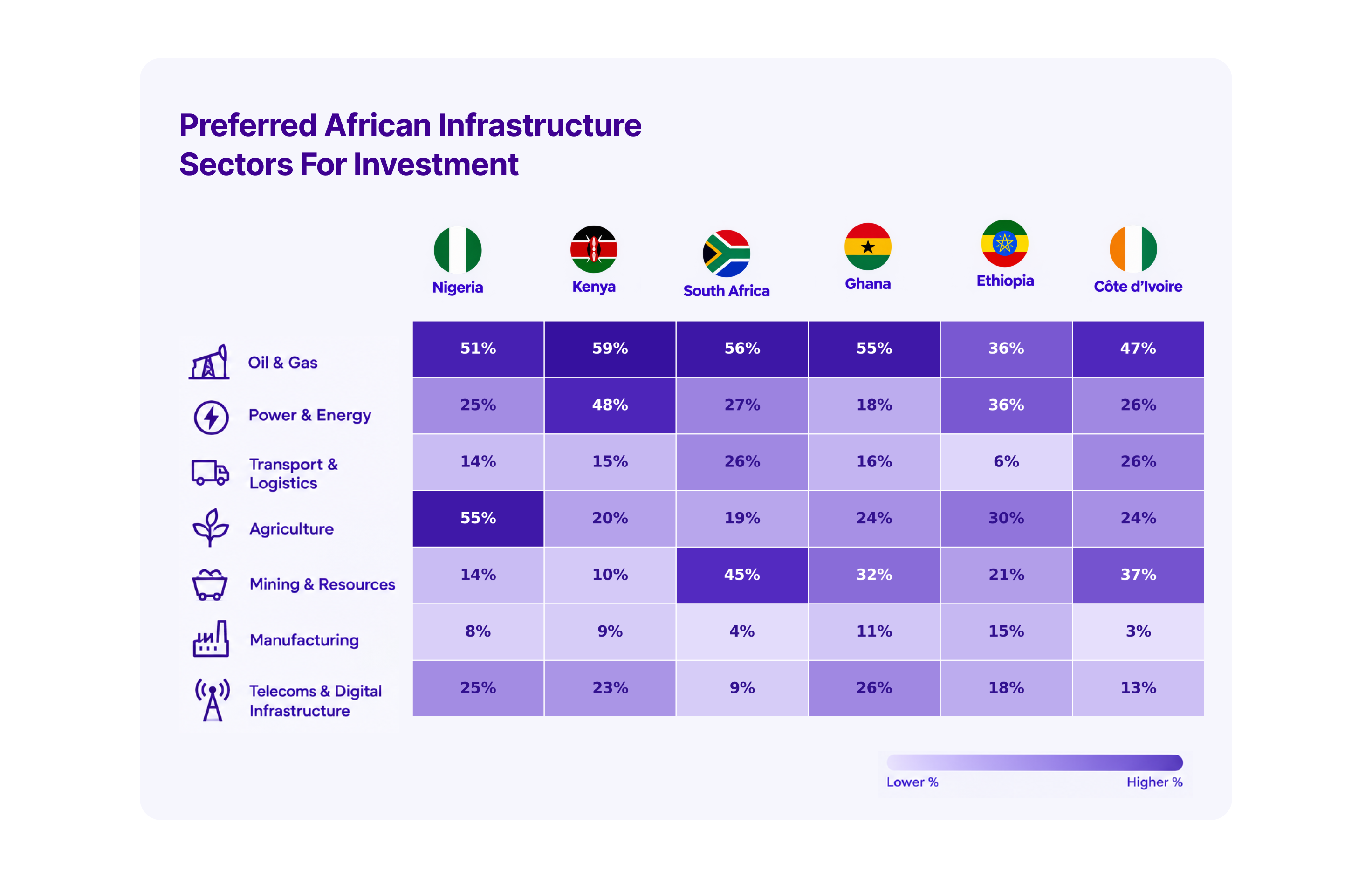
Source: Versus Africa survey via Versus Ask. Base: Filtered By: Respondents who have interest in African infrastructure investment | Nigeria (n=146) | Kenya (n=79) | South Africa (n=78) | Ghana (n=38) | Ethiopia (n=33) | Côte d’Ivoire (n=38). Percentages are based on respondents in each market. Survey participation across all countries were done from July 21st - July 29th 2026.
Insight: Among respondents who were interested in investing in African infrastructure projects, oil and gas was one of the most preferred sectors across the surveyed markets, especially in Kenya, South Africa and Ghana. Nigeria stood out for its stronger preference for agriculture, while South Africa also recorded relatively high interest in mining and resources. In Ethiopia, interest was more evenly spread between oil and gas and power and energy. This shows that while some sectors appeal across the region, investment interests are not the same in every market.
Note: Egypt was excluded, as the survey focused on African markets expected to participate in the IPO via local exchanges.
Question: Would you say your interest in investing in infrastructure is…?
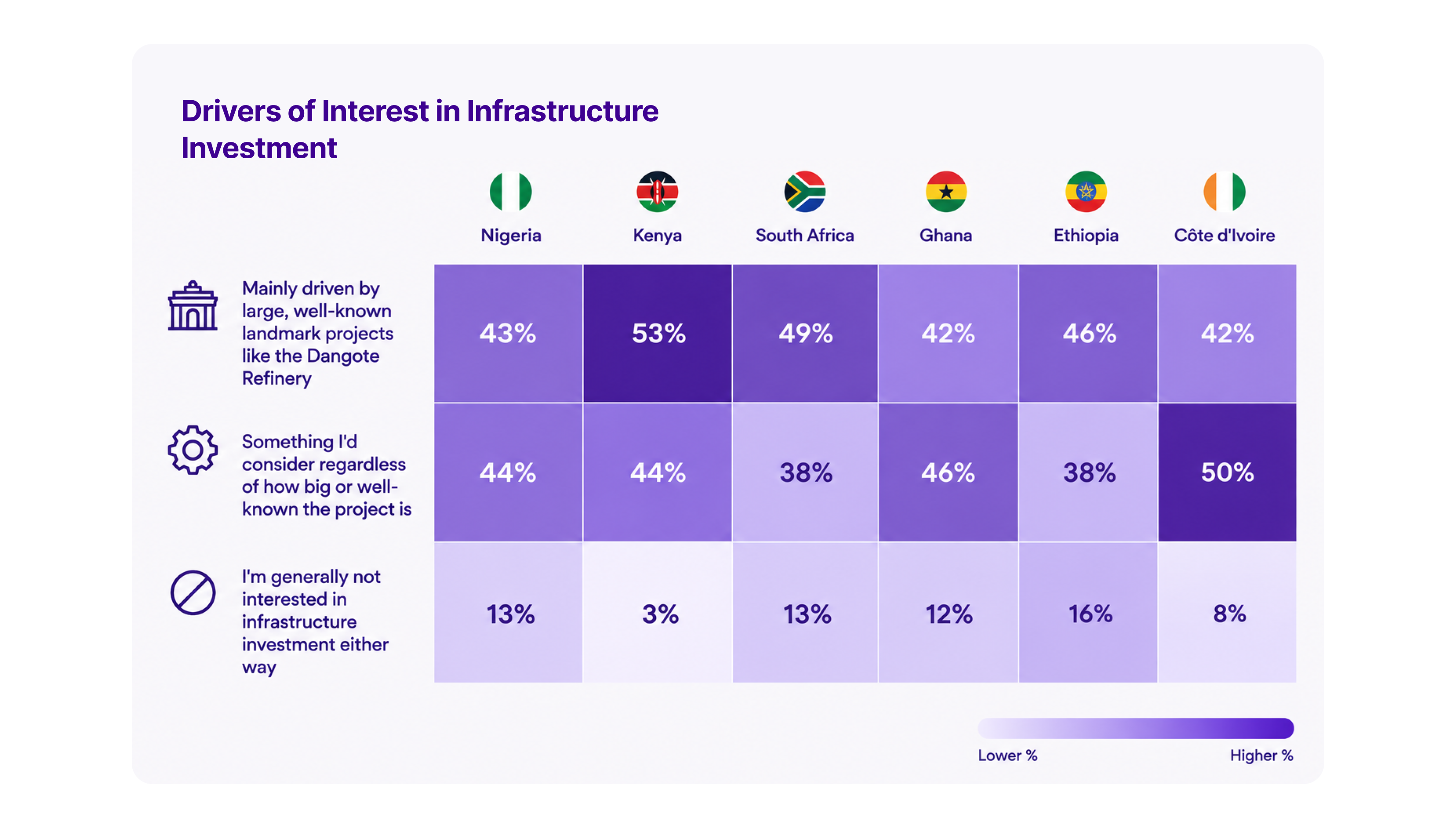
Source: Versus Africa survey via Versus Ask. Base: All Respondents (N=600)| Nigeria(n=202)| Kenya (n=100)| South Africa(n=100)| Ghana(n=50)| Ethiopia(n=50)| Côte d'Ivoire (n=50) Percentages are based on respondents in each market. Survey participation across all countries were done from July 21st - July 29th 2026.
Insight: Respondents were almost evenly split between those whose interest in infrastructure investment is driven by major projects like the Dangote Refinery and those who would invest regardless of how well known a project is. Kenya showed the strongest preference for landmark projects, while respondents in Côte d'Ivoire were more likely to invest regardless of a project's profile. Nigeria, Ghana and South Africa showed a fairly even split between the two groups. This suggests that while landmark projects can attract investor interest, investors are also open to other infrastructure opportunities if they offer good value.
Note: Egypt was excluded, as the survey focused on African markets expected to participate in the IPO via local exchanges.
Question: What is it about large, high-profile projects that makes you more likely to invest?
.png)
Source: Versus Africa survey via Versus Ask. Base: Respondents whose interest in infrastructure investment is mainly driven by large, well-known landmark projects like the Dangote Refinery | Nigeria (n=175) | Kenya (n=53) | South Africa (n=49) | Ghana (n=21) | Ethiopia (n=23) | Côte d’Ivoire (n=21). Percentages are based on respondents in each market. Survey participation across all countries were done from July 21st - July 29th 2026.
Insight: Among respondents whose interest in infrastructure investment is mainly driven by landmark projects such as the Dangote Refinery, trust emerged as the main reason for preferring high-profile investments. This was particularly evident in Ghana, Kenya and Ethiopia. South Africa stood out for placing greater emphasis on how easy a project is to research and understand, while respondents in Côte d'Ivoire were more likely than those in other markets to say that media coverage builds their confidence. This suggests that well-known projects appeal to investors because they are seen as more credible, visible and easier to evaluate before making an investment decision.
Note: Egypt was excluded, as the survey focused on African markets expected to participate in the IPO via local exchanges.
Question: How much do you trust that infrastructure investments in Africa , big or small , deliver the returns they promise?
.png)
Source: Versus Africa survey via Versus Ask. Base: All Respondents (N=600) | Nigeria (n=202) | Kenya (n=100) | South Africa (n=100) | Ghana (n=50) | Ethiopia (n=50) | Côte d’Ivoire (n=50) Percentages are based on respondents in each market. Survey participation across all countries were done from July 21st - July 29th 2026.
Insight: Most respondents expressed at least some level of trust in the returns from African infrastructure investments. Kenya and South Africa recorded the highest levels of confidence, while Ethiopia showed lower levels of trust and the highest level of scepticism. Nigeria and Ghana fell somewhere in between. This suggests that confidence in infrastructure investments is growing across the region, but there is still room to build trust in some markets.
Note: Egypt was excluded, as the survey focused on African markets expected to participate in the IPO via local exchanges.
Question: Where do you usually get news about business and investment opportunities in Africa?

Source: Versus Africa survey via Versus Ask. Base: All Respondents (N=600) | Nigeria (n=202) | Kenya (n=100) | South Africa (n=100) | Ghana (n=50) | Ethiopia (n=50) | Côte d’Ivoire (n=50). Percentages are based on respondents in each market. Survey participation across all countries were done from July 21st - July 29th 2026.
Insight: Social media was the main source of business and investment information across all six markets, particularly in Nigeria, Kenya and Ethiopia. Online news sites also played an important role, while South Africa stood out for its greater reliance on TV news and word of mouth. Financial advisers and brokers were a less common source of information across the surveyed markets. This suggests that digital platforms remain the most effective channels for reaching potential investors, although traditional media continues to play an important role in some markets.
Across the five focus markets, infrastructure investment is creating opportunities in energy, transport, logistics, agriculture and industrial development. At the same time, financing constraints, implementation risks and regulatory uncertainty continue to affect the pace and scale of investment.
Africa's infrastructure requirements exceed the capacity of public financing alone, increasing the importance of public-private partnerships (PPPs), blended finance and development finance. The Dangote Refinery demonstrates the scale of infrastructure that private capital can deliver where projects combine strong commercial potential with long-term economic value.
Implementation of the African Continental Free Trade Area (AfCFTA) is increasing the importance of cross-border transport corridors, ports, logistics networks and energy infrastructure. Improved connectivity can reduce trade costs, strengthen regional value chains and expand markets for African businesses.
Growing investment in renewable energy, electricity networks and domestic processing creates opportunities to strengthen energy security and industrialisation. Across the focus markets, projects ranging from Ethiopia's hydropower expansion to Egypt's industrial zones and Nigeria's refining capacity demonstrate the relationship between reliable infrastructure and productive investment.
Digital infrastructure is increasingly complementing physical infrastructure through broadband connectivity, data centres, smart logistics and digital public services. This creates opportunities for technology providers and investors as infrastructure systems become more connected and data-driven.
Africa's infrastructure financing gap remains a fundamental constraint. High financing costs, currency volatility and project risk can make otherwise viable infrastructure difficult to finance, particularly in markets with limited fiscal capacity.
Delays in procurement, approvals, construction and land acquisition can increase project costs and reduce investor confidence. Existing infrastructure also requires sustained maintenance to prevent deterioration and preserve the value of previous investment.
Long-term infrastructure investment depends on predictable regulation, transparent procurement and effective governance. Policy uncertainty can increase risk and discourage the private capital required to close infrastructure gaps.
Infrastructure must increasingly account for floods, droughts, extreme temperatures and other climate risks. Integrating resilience into project design and asset management will be important for protecting long-term investment.
The findings of this study have practical implications beyond infrastructure developers themselves.For investors, the infrastructure financing gap creates substantial long-term opportunities, but market selection must consider project bankability, regulatory stability, currency risk and execution capacity. The survey findings also suggest that visibility of a major infrastructure project does not automatically translate into investor understanding or willingness to invest.For brands and businesses, infrastructure investment can reshape market access, operating costs and consumer demand. Companies in logistics, construction, energy, financial services, technology, manufacturing and agribusiness can use infrastructure pipelines to identify where new commercial ecosystems are likely to emerge.For policymakers and development partners, attracting sustainable private investment will require stronger project preparation, predictable regulation and financing structures capable of reducing risk. Public communication is also important where infrastructure projects are intended to attract broader institutional or retail participation.
Africa's infrastructure gap is simultaneously a development constraint and an investment opportunity. The strongest opportunities are likely to emerge where infrastructure connects multiple economic activities, energy with industry, transport with trade, or logistics with agriculture, while projects that combine credible financing, effective implementation and clear economic value will be best positioned to attract long-term capital.
Africa's infrastructure landscape is entering a new phase shaped by regional integration, private-sector participation, sustainable energy and increasingly interconnected infrastructure systems. Across the five focus markets, investment priorities differ, but the underlying objective is consistent: improving productive capacity, strengthening connectivity and creating the conditions for long-term economic growth.
The country profiles illustrate different pathways. Kenya is strengthening regional connectivity and agricultural value chains; South Africa is focused on restoring and modernising mature infrastructure; Egypt is leveraging manufacturing, tourism and logistics; Ethiopia is connecting expanded energy capacity with transport and agricultural exports; and Nigeria demonstrates the scale of opportunity created by addressing major energy, agricultural and industrial infrastructure gaps.
The Dangote Refinery provides perhaps the clearest example of how this next phase could evolve. Its integration of industrial capacity, energy, logistics and supporting infrastructure demonstrates the potential for large-scale private investment to strengthen domestic value addition and regional trade. Its proposed transition towards a publicly listed company also raises a broader question for African infrastructure: whether major privately financed assets can increasingly provide opportunities for wider investor participation.
Looking ahead, five trends are likely to shape infrastructure development across the continent:
Africa's infrastructure financing gap remains substantial, but the findings of this study show that the opportunity extends beyond simply building more assets. The next phase will increasingly depend on how infrastructure systems connect energy, production, transport, technology and markets.For investors, businesses and policymakers, understanding these connections will be essential to identifying where infrastructure investment can generate both sustainable commercial returns and wider economic value.
Interested in the Dangote Refinery IPO? The offer opens from Monday, 14th September 2026 through October 13th, 2026. Register your interest and subscribe via our partners, Futureview →
2026 Enterfive Inc. All Rights Reserved


